Transport management system selection steps: 2026 guide
Discover essential transport management system selection steps to minimize risk and maximize savings in 2026. Make informed decisions today!
Transport management system selection steps: 2026 guide

A transport management system (TMS) is defined as software that plans, executes, and monitors the physical movement of goods. Choosing the right one is one of the highest-stakes decisions a logistics manager makes. The transport management system selection steps that matter most in 2026 are not about finding the longest feature list. They are about managing execution risk before you sign anything. Companies with modern TMS platforms report 5% freight cost savings, 20% better on-time delivery, and 60% time savings on quoting. Those numbers show what a well-chosen system delivers. They also show what a poor choice costs you.
What prerequisites do you need before starting TMS selection?
The foundation of any successful TMS evaluation is clean internal data and a clearly defined transport strategy. Without these, you cannot write a meaningful requirements document, and vendors will fill the gaps with assumptions that favour their product.
Start by auditing your current operations. Map your freight volumes by lane, mode, and carrier. Identify where manual processes create bottlenecks, where invoicing errors occur, and where visibility breaks down. AI tools assist early market research, but they cannot replace formal structured analysis and domain expertise. Your internal architecture assessment must come first.

Stakeholder alignment is equally non-negotiable. Procurement, IT, operations, and finance all have different priorities. A TMS that satisfies operations but cannot connect to your ERP will fail within twelve months. Bring all departments into the requirements process before you contact a single vendor.
Checklist before you begin vendor outreach:
- Documented freight volumes by lane, mode, and carrier
- Current system inventory including ERP, WMS, and carrier portals
- API and EDI capability assessment for existing platforms
- Named project owner with authority across IT and operations
- Budget range including integration, training, and change management costs
- Defined success metrics tied to freight cost, delivery performance, and admin time
Pro Tip: Map your worst-performing lanes first. These are the scenarios you will use in vendor demos later. If a system cannot handle your hardest problems, it will not handle your easy ones either.
What are the systematic steps to evaluate and shortlist TMS vendors?
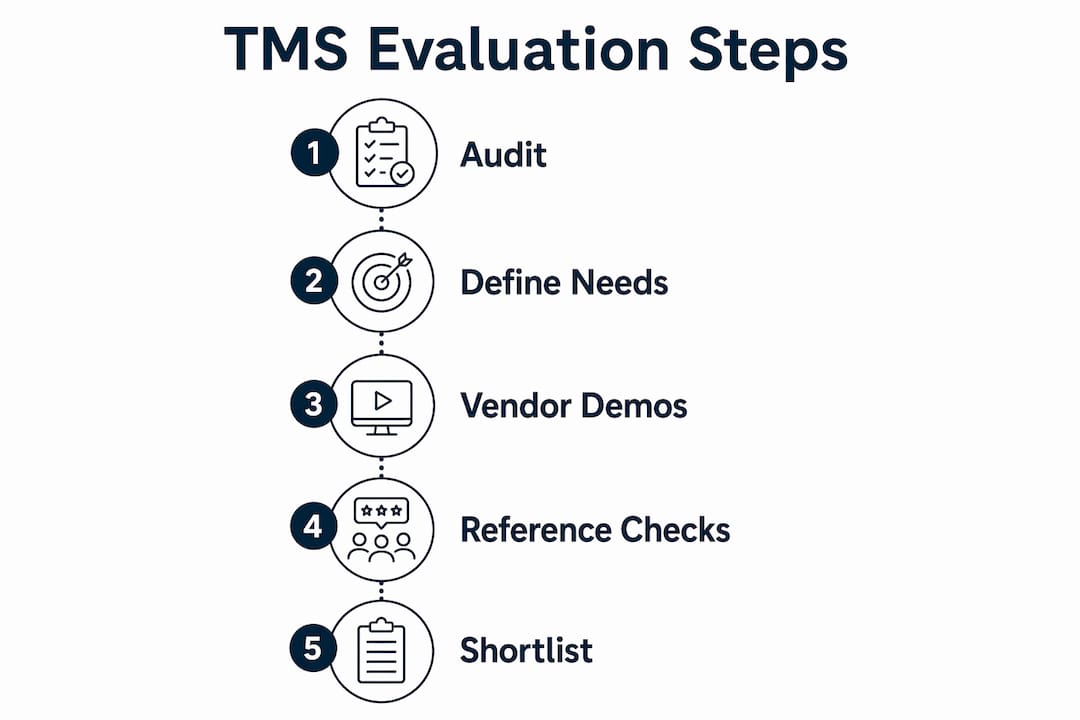
Vendor evaluation fails when buyers treat it as a product demonstration exercise. The structured approach treats it as a risk management process, where every vendor interaction is designed to surface integration risk, pricing volatility, and support gaps.
Follow these steps in sequence:
-
Issue a structured RFI. Send a written request for information to a longlist of vendors. Ask for architecture diagrams, integration case studies, and reference customers in your freight segment. This filters out vendors who cannot handle your volume or complexity before you invest time in demos.
-
Run shared Q&A windows. Require all shortlisted vendors to submit questions in writing. Publish all questions and answers to every vendor simultaneously. This removes information asymmetry and makes vendor responses directly comparable.
-
Score functional fit against your requirements. Use a weighted scorecard. Assign higher weights to integration capability, real-time visibility, and reporting than to UI aesthetics. A system that looks good but cannot connect to your carriers is a liability.
-
Demand demos using your own data. Generic vendor demos provide limited value compared to scenarios using real shipping lanes and parameters. Send vendors your actual lane data and ask them to demonstrate route optimisation, carrier selection, and exception handling with it.
-
Scrutinise total cost of ownership. Licence fees represent only 20–25% of total TMS budget. Integration, customisation, and training account for the remaining 75–80%. Any vendor who presents only licence costs in their proposal is obscuring the real financial picture.
-
Review contract terms for pricing volume clauses. Some contracts include pricing escalators tied to shipment volume. If your freight grows, your costs can spike unexpectedly. Negotiate fixed pricing bands or caps before signing.
Pro Tip: Ask each vendor for two reference customers who went live within the last eighteen months. Call them directly. Ask specifically about integration timelines and what they wish they had known before signing.
How should you plan and execute the TMS implementation phase?
Implementation is where most TMS projects fail. 76% of logistics transformations fail to meet performance objectives, primarily because of integration friction and execution risk mismanagement. The selection process can be perfect, and the rollout can still collapse if the implementation plan is unrealistic.
The first rule is to reject any vendor promise of a multi-week go-live. Realistic TMS implementation takes 8–12 months. Anything shorter either means a very limited scope or a vendor who is not being honest with you.
Phased rollout versus big-bang implementation
| Approach |
Timeline |
Risk level |
Best suited for |
| Phased rollout |
8–12 months |
Low to medium |
Most organisations |
| Big-bang implementation |
3–6 months |
High |
Small, simple operations only |
A phased rollout starts with your highest-volume, simplest lanes. This gives your team time to learn the system, surface integration issues early, and measure results before adding complexity. Phasing by complexity and volume helps organisations absorb change and measure progress realistically.
Big-bang implementation attempts to go live across all lanes and modes simultaneously. For most logistics operations, this creates unmanageable risk. A single integration failure can halt your entire freight operation.
Clear project ownership is the single most important governance decision you make. Assign one person with authority over IT, operations, and vendor coordination. Committees make slow decisions. A single project owner makes fast ones.
Training must be built into the project timeline, not added at the end. Allocate time for role-specific training across dispatchers, finance staff, and management. A system that nobody uses correctly delivers no value regardless of its capabilities.
Pro Tip: Build a parallel-run period of at least four weeks where your old system and the new TMS operate simultaneously. This catches data discrepancies before they affect live shipments.
Which TMS features and criteria are most critical in 2026?
The criteria for TMS evaluation have shifted significantly. Real-time visibility, AI decision support, and multi-modal capability are now baseline expectations, not premium features. A detailed feature overview shows how these capabilities translate into daily operational gains.
Must-have features for 2026:
- Real-time shipment visibility with carrier-agnostic tracking and exception alerts
- AI-assisted route and carrier optimisation that learns from your historical data
- Multi-modal support covering road, rail, sea, and air within a single platform
- Hybrid EDI and API integration. Effective handling of legacy XML and flat files alongside real-time APIs is mandatory for any operation with established carrier relationships.
- Automated invoicing and freight audit to reduce billing errors and disputes
- Role-based access controls to protect sensitive rate and customer data
- eFTI compliance readiness for European freight operators, as electronic freight transport information regulations continue to expand
Beyond features, evaluate the vendor’s support model. A system with strong functionality but slow support creates operational risk every time something breaks. Ask vendors for their average response time on critical issues and get it written into the contract.
Scalability matters too, but define it concretely. Ask vendors how their pricing and performance change at twice your current volume. Vague answers about “growing with your business” are not acceptable. You need specific numbers.
The TMS benefits for hauliers extend well beyond cost savings. Reduced administrative workload, fewer invoicing errors, and better customer visibility all contribute to operational performance that compounds over time.
Key takeaways
Selecting a TMS without a structured process costs more in integration failures and operational disruption than the licence fee ever will.
| Point |
Details |
| Audit before you evaluate |
Map freight volumes, current systems, and pain points before contacting any vendor. |
| Total cost of ownership |
Licence fees cover only 20–25% of TMS budget; integration and training drive the rest. |
| Use real data in demos |
Generic demos reveal little; send vendors your actual lane data to test genuine fit. |
| Phase the rollout |
Start with high-volume, simple lanes to reduce risk and measure progress early. |
| Assign one project owner |
A single owner with cross-functional authority accelerates decisions and reduces coordination failures. |
What I have learned from watching TMS projects succeed and fail
The most common mistake I see is treating TMS selection as a feature shopping exercise. Logistics managers spend weeks comparing dashboards and mobile apps, then sign a contract without properly testing the integration path between the new system and their existing ERP. Six months later, the project is stalled because the data exchange does not work as promised.
The second mistake is underestimating the human side of implementation. A system change affects dispatchers, finance teams, and drivers simultaneously. If you do not invest in training and change management, you will get workarounds and shadow processes that undermine the entire investment.
The third thing I would tell any logistics manager is to read the contract before the demo. Pricing volume clauses and support tier limitations are buried in terms that sales teams rarely volunteer. The TMS comparison process should include legal review of shortlisted contracts, not just technical evaluation.
The logistics environment in 2026 adds regulatory pressure on top of operational complexity. eFTI requirements, carbon reporting obligations, and cross-border data standards all affect which system you need. A TMS that is compliant today but has no roadmap for upcoming regulation is a liability you are buying on purpose.
My honest recommendation: spend 30% of your evaluation time on integration architecture and 30% on reference calls. The remaining 40% can cover features, pricing, and everything else. That allocation reflects where projects actually succeed or fail.
— Vytautas
How Logivo supports your TMS selection and operations
Selecting the right system is only half the work. Putting it into practice without disruption is the other half.
Logivo offers a guided one-month trial that lets you validate AI-driven recommendations against your actual freight data before committing. The platform automates job allocation, delivery tracking, and invoicing within a single system, which directly addresses the administrative overhead that most logistics managers cite as their biggest daily cost. Logivo’s live driver map and transport invoicing tools give operations and finance teams real-time visibility without requiring separate platforms. For European freight operators, Logivo’s EU freight solution is built around the regulatory and carrier requirements specific to cross-border operations. Role-based access and a clear security architecture mean your rate data and customer information stay protected from day one.
FAQ
What are the main steps in TMS selection?
The core transport management system selection steps are: audit your current operations, define requirements with all stakeholders, issue a structured RFI, evaluate vendors using your own freight data, assess total cost of ownership, and plan a phased implementation. Each step builds on the previous one.
How long does TMS implementation realistically take?
Realistic TMS implementation takes 8–12 months for most logistics operations. Vendor promises of multi-week go-lives typically apply only to very limited scopes and should be treated with scepticism.
What percentage of TMS budget goes beyond the licence fee?
Integration, customisation, and training account for 75–80% of total TMS budget. Licence fees cover only 20–25%. Budget failures occur most often when these ancillary costs are underestimated or ignored during procurement.
What integration capabilities should a TMS have in 2026?
A TMS must support hybrid EDI and API workflows, handling both legacy XML and flat file formats alongside real-time API connections. This is non-negotiable for any operation with established carrier or ERP relationships.
How do I reduce the risk of a failed TMS rollout?
Assign a single project owner with cross-functional authority, start the rollout on your highest-volume and simplest lanes, and build a parallel-run period of at least four weeks. These three practices address the integration friction and scope overreach that cause most implementation failures.
Recommended