Role of a dispatcher in logistics: 2026 guide
Discover the role of dispatcher in logistics for 2026. Learn how effective dispatching boosts fleet efficiency and ensures compliance.
Role of a dispatcher in logistics: 2026 guide

A logistics dispatcher is defined as the operational coordinator responsible for managing fleet movements, driver scheduling, compliance monitoring, and real-time communication across the supply chain. The role of dispatcher in logistics sits at the centre of every freight operation, connecting drivers, customers, carriers, and management into a single functioning unit. Dispatchers manage critical constraints including Hours of Service (HOS) regulations, vehicle availability, and delivery windows simultaneously. Without effective dispatch, even well-resourced fleets lose money through missed loads, compliance breaches, and poor documentation.
What are the primary responsibilities of a logistics dispatcher?
Dispatcher responsibilities in logistics cover far more than assigning loads to drivers. The core duty is matching the right driver, vehicle, and route to each job based on availability, HOS compliance, and equipment type. Dispatchers then monitor progress in real time, responding immediately to delays, breakdowns, and customer changes.
Daily logistics dispatcher tasks include:
- Load assignment: Matching loads to drivers based on hours available, licence class, and vehicle capacity.
- Route planning: Selecting efficient routes that account for traffic, weight restrictions, and delivery windows.
- HOS compliance monitoring: Tracking Electronic Logging Device (ELD) data to prevent violations under regulations such as the EU Drivers’ Hours Rules or FMCSA standards in North America.
- Documentation management: Chasing signed Proof of Delivery (POD) and Bills of Lading (BOL) to trigger invoicing. Invoice documentation must be submitted within 24 hours to protect fleet cash flow.
- Customer and carrier communication: Providing status updates, managing expectations, and negotiating rates on the spot market.
- Exception handling: Coordinating responses to breakdowns, traffic incidents, and last-minute shipper changes.
Pro Tip: Set a hard rule that drivers submit signed POD photos via a mobile app immediately upon delivery. Waiting until end of shift costs fleets days in payment cycles.
Dispatchers also use Transportation Management Systems (TMS) and GPS tracking platforms to maintain visibility across the fleet. These tools reduce manual check-in calls and give dispatchers a live picture of every vehicle’s position and status.

Which skills make an effective logistics dispatcher?
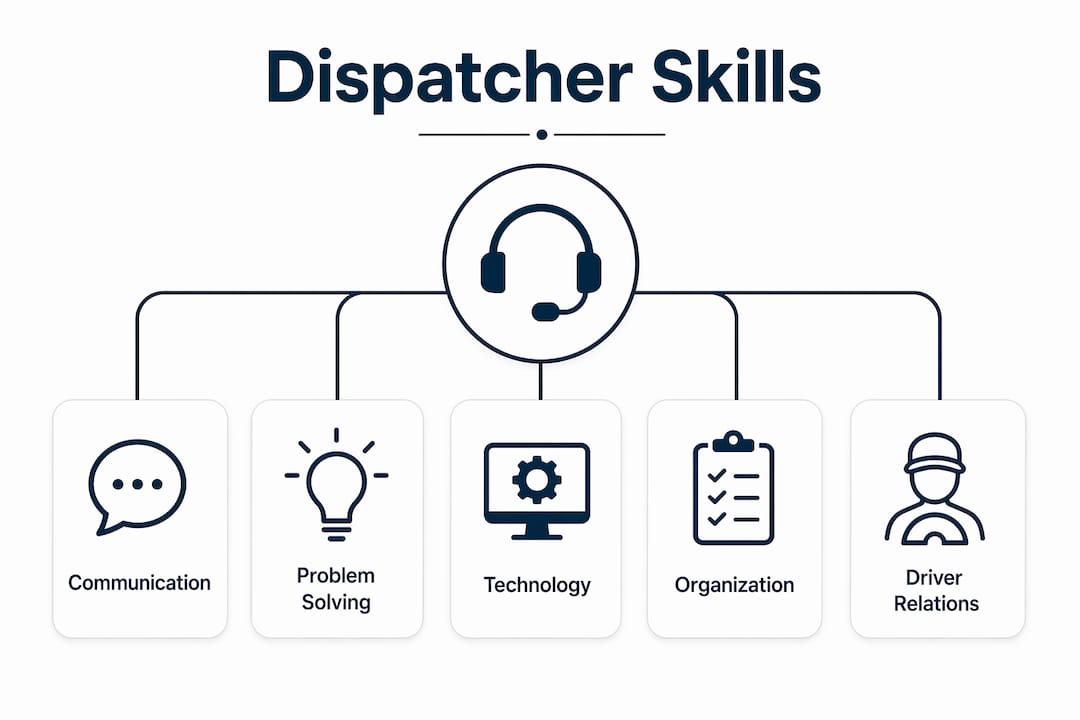
Effective dispatching requires a specific combination of technical knowledge, interpersonal ability, and analytical thinking. No single skill dominates. The best dispatchers combine all three in real time, often under significant pressure.
The core competencies include:
- Regulatory knowledge: Understanding HOS rules, weight limits, and hazardous goods classifications prevents costly compliance failures.
- Multitasking under pressure: A dispatcher managing 20 drivers simultaneously must triage competing priorities without losing accuracy.
- Negotiation: Experienced dispatchers add measurable value through spot market negotiation, securing better rates and protecting margins.
- Communication: Clear, direct communication with drivers, brokers, and customers reduces misunderstandings that cause delays.
- Data literacy: Reading TMS dashboards, interpreting GPS data, and spotting patterns in delivery performance all require comfort with numbers.
- Problem-solving: Breakdowns, missed collections, and weather events demand fast, practical decisions without a script.
The strategic mindset required of a modern dispatcher transforms the role from routine job assignment into a dynamic balancing act involving driver welfare, compliance, and customer requirements. Logistics managers who treat dispatching as a clerical function consistently underperform those who invest in skilled, experienced coordinators.
Driver satisfaction management is an underappreciated dispatcher skill. Dispatchers who build trust with drivers see lower turnover, which directly reduces recruitment and training costs across the fleet.
What challenges do dispatchers face in managing operations?
The workload of a logistics dispatcher scales quickly with fleet size, and the ratio of drivers to dispatchers is a critical operational metric. Industry standards set the optimal range at 15–40 drivers per dispatcher. Exceeding 40 drivers per dispatcher causes service degradation and increases operational costs.
Managing within that ratio is harder than it sounds. Drivers operate across different time zones, shift patterns, and load types. A single breakdown at 2:00 AM can cascade into missed morning deliveries, customer complaints, and a compliance investigation if HOS records are not handled correctly.
Pro Tip: Build a daily exception log. Recording every deviation, breakdown, and late delivery creates a pattern database that helps dispatchers predict and prevent recurring problems.
Documentation failures represent one of the most financially damaging challenges in dispatch operations management. Missing or delayed paperwork causes payment delays that threaten cash flow, particularly in smaller fleets operating on thin margins. Detention, layover, and TONU (Truck Ordered Not Used) fees are legitimate revenue sources that many dispatchers fail to document and bill consistently. A dispatcher who misses three TONU charges per week across a 20-truck fleet loses a material amount of revenue annually.
Automation helps with routine scheduling but does not replace human judgement. Complex exception handling such as rerouting around a motorway closure or managing a driver welfare situation still requires a person who understands context, relationships, and consequences. The limitation of automated systems is that they optimise for the variables they can see. Dispatchers account for the variables they cannot.
Technology has changed the practical execution of dispatch operations without replacing the dispatcher’s judgement. The use of TMS and GPS tracking greatly enhances route planning, communication, and compliance monitoring across the fleet.
The most impactful tools in a modern dispatch workflow are:
- Transportation Management Systems (TMS): Centralise load planning, driver assignment, and customer communication in one platform. Dispatchers can view all active jobs, driver status, and delivery progress without switching between systems.
- Electronic Logging Devices (ELD): Automatically record driving hours and flag HOS risks before they become violations. This removes the manual burden of paper log auditing.
- GPS and live driver maps: Give dispatchers real-time vehicle positions, enabling proactive rerouting and accurate customer ETAs. Logivo’s live driver map provides this visibility alongside customer-facing tracking links.
- Mobile driver apps: Allow drivers to submit POD photos, accept loads, and communicate with dispatch directly from their cab, reducing phone call volume significantly.
- Customer portals: Give shippers self-service access to shipment status, reducing inbound enquiries and freeing dispatcher time for exception handling.
The difference between entry-level dispatch tools and enterprise platforms lies primarily in integration depth. Basic tools handle scheduling. Advanced platforms connect scheduling, compliance, invoicing, and customer communication into a single workflow. That integration is where dispatchers recover the most time.
The practical impact of technology on dispatch accuracy is significant. Fleets using integrated TMS report fewer missed collections, faster invoice cycles, and better driver utilisation. The jobs grid feature in platforms like Logivo gives dispatchers a structured view of all active and pending jobs, reducing the risk of loads falling through the gaps during busy periods.
Automation handles the predictable. The dispatcher handles everything else. That division of labour, when structured correctly, produces the best outcomes for fleet performance and customer satisfaction.
Key takeaways
The dispatcher’s role is the operational backbone of any freight business, combining compliance management, real-time coordination, and financial discipline into a single function.
| Point |
Details |
| Dispatcher workload limits |
The industry standard is a maximum of 40 drivers per dispatcher to maintain service quality. |
| Documentation drives cash flow |
Signed POD and BOL must be submitted within 24 hours to avoid payment delays. |
| Human judgement remains critical |
Automation handles routine tasks, but exception handling still requires experienced human decision-making. |
| Revenue protection through billing |
Detention, layover, and TONU fees must be documented consistently to protect fleet profitability. |
| Technology multiplies dispatcher capacity |
TMS, ELD, and GPS tools reduce manual workload and improve compliance and communication across the fleet. |
The dispatcher is the most undervalued role in freight
I have worked with logistics operations of every size, from owner-operators running three trucks to regional fleets with 200 vehicles. The pattern I see repeatedly is that management invests heavily in vehicles, fuel contracts, and warehouse technology, then treats the dispatcher position as an administrative afterthought.
That is a costly mistake. A skilled dispatcher does not just fill seats in trucks. They protect margins through negotiation, prevent compliance fines through proactive HOS monitoring, and retain drivers through consistent, fair communication. The strategic evolution of dispatching into a genuine operational management function is one of the most significant shifts in modern freight.
What concerns me most in 2026 is the assumption that AI and automation will eventually replace the dispatcher entirely. The reality is the opposite. As freight networks grow more complex and customer expectations for real-time visibility increase, the dispatcher’s role becomes more demanding, not less. Automation removes the repetitive work. It does not remove the need for someone who can make a sound judgement call at 11:00 PM when a driver is stranded and a delivery is due at 6:00 AM.
The misconception that dispatching is purely clerical persists because the best dispatchers make the job look easy. They do not. They make it look easy because they are very good at something genuinely difficult.
— Vytautas
How Logivo supports dispatch teams in daily operations
Dispatchers who manage high driver-to-coordinator ratios need tools that reduce administrative load without sacrificing visibility. Logivo’s transport management software brings load planning, real-time tracking, driver communication, and invoicing into a single platform, giving dispatch teams the clarity they need to manage more with less effort.
Logivo automates job allocation and delivery tracking, cutting the time dispatchers spend on manual updates. The platform’s proof of delivery tools capture signed documentation at the point of delivery, accelerating invoice cycles and protecting cash flow. Firms using Logivo report fewer invoicing errors and measurable reductions in administrative overhead. A guided one-month trial lets dispatch teams validate the results before committing.
FAQ
What is the role of a dispatcher in logistics?
A logistics dispatcher coordinates fleet movements, assigns loads to drivers, monitors compliance, and manages communication between drivers, customers, and carriers. The role is the primary operational contact for real-time issue resolution across the fleet.
How many drivers can one dispatcher manage effectively?
Industry standards set the optimal range at 15–40 drivers per dispatcher. Exceeding 40 drivers per dispatcher leads to service degradation and higher operational costs.
Why is documentation so critical in dispatch operations?
Dispatchers must submit complete invoice packets, including signed Proof of Delivery and Bill of Lading, within 24 hours. Delayed paperwork causes payment delays that directly threaten fleet cash flow, particularly for smaller operators.
What technology do dispatchers use to manage their workload?
Dispatchers rely on Transportation Management Systems, Electronic Logging Devices, GPS tracking, and mobile driver apps to maintain fleet visibility, monitor HOS compliance, and reduce manual communication volume.
Can automation replace a logistics dispatcher?
Automation handles routine scheduling and data entry, but complex exception handling such as breakdowns, last-minute route changes, and driver welfare situations still requires human judgement and coordination.
Recommended