Freight allocation steps: a 2026 guide for dispatchers
Learn how to streamline freight allocation steps in 2026. Improve delivery performance, cut costs by up to 40%, and boost efficiency.
Freight allocation steps: a 2026 guide for dispatchers

Freight allocation is defined as the process of assigning shipments to carriers, routes, and capacity in a way that meets delivery commitments at the lowest viable cost. Getting those steps right is the single biggest lever logistics managers and dispatchers have over transport spend and service performance. Optimised allocation cuts transport costs by 25–40% and lifts on-time delivery rates by up to 11 percentage points. That is not a marginal gain. It is the difference between a profitable lane and a loss-making one. The steps to streamline freight allocation steps begin before a single booking is made, and they depend on clean data, clear rules, and the right tools.
What prerequisites are needed to streamline freight allocation steps?
Load readiness is the first gate in any allocation workflow. Validating labels, packaging, and paperwork before a shipment enters the routing queue prevents wasted driver time and missed delivery appointments. Skipping this step is the most common cause of last-minute allocation failures, yet it is also the easiest to fix with a simple checklist embedded in your transport management system (TMS).
Shipment data accuracy matters just as much as physical readiness. Weight, dimensions, hazard classifications, and delivery windows must all be confirmed before carrier sourcing begins. Errors at this stage cascade downstream, producing incorrect rate quotes, wrong vehicle assignments, and compliance failures at the point of delivery.

The tools required at this stage fall into three categories: a TMS for routing logic, an allocation tracking dashboard for visibility, and an EDI or API connection to carrier systems for real-time confirmation. Without all three, allocation decisions rely on manual checks that slow the process and introduce errors.
| Prerequisite |
Why it matters |
| Load readiness check |
Prevents driver idle time and missed appointments |
| Shipment data validation |
Eliminates rate and compliance errors downstream |
| TMS with routing logic |
Automates carrier matching against business rules |
| Allocation tracking dashboard |
Gives dispatchers real-time visibility of booking status |
| EDI or API carrier connection |
Enables timed tendering and automated confirmation |
Pro Tip: Build your load readiness checklist directly into your TMS intake form. If a field is incomplete, the system should block the shipment from entering the routing queue entirely.
What are the step-by-step procedures for efficient freight allocation?
A well-structured allocation workflow follows a fixed sequence. Each step feeds the next, and skipping any one of them creates a bottleneck that compounds over time. The industry standard for priority-based allocation models requires clear business rules and automated real-time decision systems to reduce logistics costs by 15–25%.
- Capture the freight request. Record shipment details including origin, destination, weight, dimensions, commodity type, and required delivery date. All fields must be validated before the record moves forward.
- Check contracted capacity first. Review your Blanket Service Agreements (BSAs) and preferred carrier commitments before touching the spot market. Failing to use contracted capacity before spot market options risks dead freight penalties and overspending.
- Tender to preferred carriers with a timed window. Allocation tiers with a 15-minute acceptance window balance carrier relationships with operational speed. If the preferred carrier does not respond, the system cascades automatically to the next tier.
- Automate the tendering sequence. Automated load-tendering with timed response clocks via API or EDI 204 integration eliminates manual follow-ups and re-keying errors. For next-day pickups, a 30-minute response window is the recommended standard.
- Confirm booking and update the allocation record. Once a carrier accepts, the TMS should auto-generate the booking reference, update the jobs grid, and trigger any required customer notifications.
- Manage post-confirmation changes. Amendments to weight, timing, or routing must be re-tendered through the same tier sequence. Ad hoc changes made outside the system break audit trails and create billing disputes.
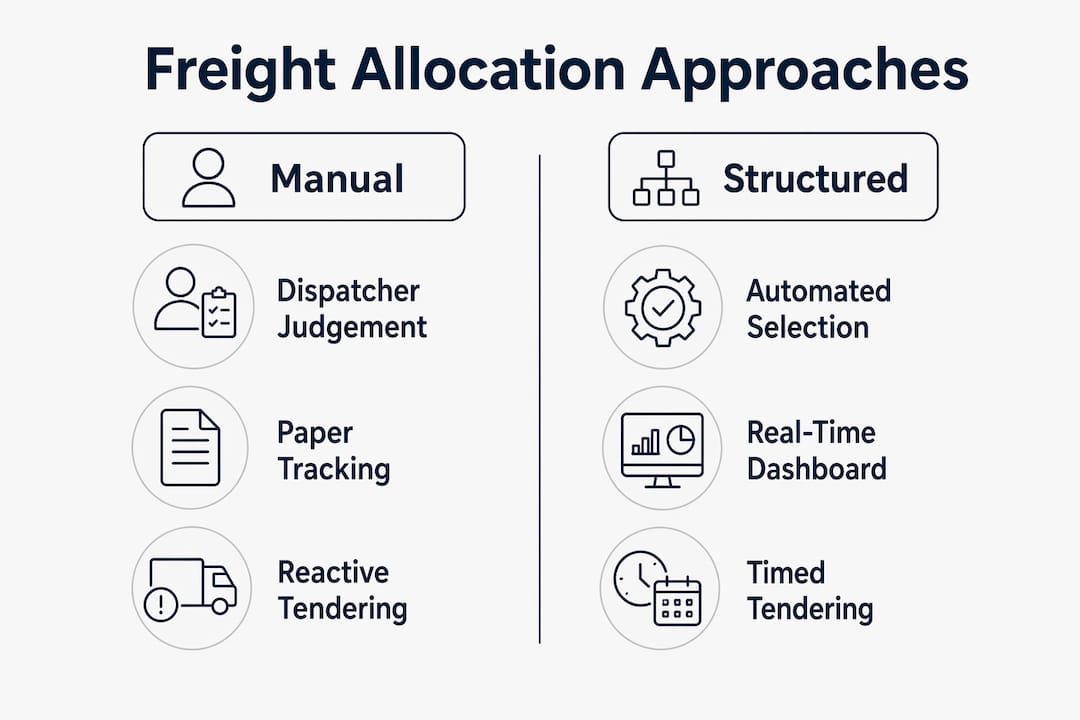
The table below compares the feature categories that separate a well-structured allocation approach from a manual one.
| Feature category |
Manual approach |
Structured approach |
| Carrier selection |
Dispatcher judgement |
Rule-based tier cascade |
| Tendering |
Phone or email |
API or EDI with timed windows |
| Contracted capacity tracking |
Periodic review |
Daily automated tracking |
| Exception handling |
Reactive |
Pre-defined escalation rules |
| Cost visibility |
Opaque overhead |
Lane-level cost allocation |
Pro Tip: Set your EDI 204 response windows differently by shipment urgency. Same-day pickups warrant a 15-minute window; standard next-day freight can run to 30 minutes. This single adjustment reduces spot market spend without changing your carrier relationships.
Logivo supports this entire sequence within one platform, automating job allocation and carrier tendering so dispatchers spend time on exceptions rather than routine bookings. The 2026 logic of automation in modern TMS platforms makes this level of rule-based control accessible to mid-sized operators, not just enterprise fleets.
How do you monitor and adjust freight allocations during execution?
Real-time tracking is not the same as GPS location. Milestone-based tracking records specific events: departure from origin, arrival at intermediate hub, customs clearance, and proof of delivery. Each milestone triggers a status update in the TMS and alerts the dispatcher if a window is missed. GPS alone tells you where a vehicle is. Milestones tell you whether the shipment is on schedule.
Integrating tracking data with planning tools closes the feedback loop. When a missed pickup is recorded, the system should automatically flag the affected booking, notify the carrier, and present the dispatcher with re-allocation options ranked by cost and transit time. Without this integration, dispatchers discover exceptions through customer complaints rather than system alerts.
Responding to capacity changes mid-execution requires a pre-defined escalation path. The steps are straightforward:
- Identify the affected shipment and its contracted carrier tier.
- Check whether an alternative contracted carrier has available capacity on the same lane.
- If not, access the spot market with a pre-approved rate ceiling to avoid overspending.
- Update the allocation record and notify the customer with a revised estimated time of arrival.
Pro Tip: Use appointment window data, not just delivery dates, when re-allocating during execution. A carrier who can deliver within the appointment window at a higher rate is almost always cheaper than a missed-appointment penalty.
Logivo’s live driver map gives dispatchers milestone visibility and customer tracking in one view, removing the need to cross-reference separate systems during execution.
What are the best practices and common pitfalls in freight allocation?
The most costly pitfall in freight allocation is treating contracted and spot capacity as interchangeable. Contracted volume tracking against BSAs must be daily, not periodic. Operators who review BSA utilisation weekly routinely overshoot spot market spend because they cannot see the contracted gap in real time.
A second pitfall is excessive GL code granularity. Overly granular GL codes create reporting noise and reduce the clarity of freight cost data. The fix is structured allocation rules applied automatically by the TMS and ERP, not manual code assignments made by individual dispatchers. Manual assignments introduce inconsistency that makes lane-level profitability analysis unreliable.
Freight cost allocation is a discipline in its own right. Allocating costs by lane, product, or customer channel shifts freight spend from an opaque overhead line to a managed variable cost. That shift makes re-pricing decisions and profitability analysis possible at a granular level. Operators who do not practise structured cost allocation cannot accurately price their services.
The best practices that prevent these pitfalls are:
- Maintain a daily BSA utilisation report visible to both planners and dispatchers.
- Use no more than three GL code tiers for freight: mode, lane, and customer segment.
- Apply allocation rules automatically through the TMS rather than relying on dispatcher memory.
- Review carrier tier performance monthly and adjust acceptance windows based on actual response data.
- Use advanced algorithmic frameworks such as constraint-based models to handle complex multi-lane allocations, which research shows can reduce logistics costs by 15–22% while maintaining high service coverage.
Key takeaways
Efficient freight allocation requires daily contracted capacity tracking, automated tendering tiers, and structured cost allocation rules applied consistently across every shipment.
| Point |
Details |
| Load readiness first |
Validate labels, paperwork, and data before any shipment enters the routing queue. |
| Contracted capacity before spot |
Check BSA commitments daily to avoid dead freight penalties and spot overspend. |
| Timed tendering tiers |
Use 15-to-30-minute acceptance windows to balance carrier relationships with speed. |
| Milestone tracking over GPS |
Record specific shipment events to catch exceptions before customers do. |
| Structured cost allocation |
Allocate freight costs by lane and customer channel to enable accurate re-pricing. |
Why I think most allocation problems are self-inflicted
After years of working with transport operations of varying sizes, the pattern I see most often is this: the allocation process itself is not the problem. The problem is that operators design their allocation rules once, during implementation, and then never revisit them. Carrier performance changes. Lane volumes shift. BSA terms expire. But the rules in the TMS stay static, and dispatchers quietly work around them rather than updating them.
The result is a system that looks automated on paper but is actually driven by individual dispatcher habit. One person knows to always call Carrier A first on the northern lane. Another always goes straight to spot because the preferred carrier “never answers.” Neither behaviour is captured in the system, and neither is visible to management.
The operators I have seen make the most sustained gains from allocation work are the ones who treat their allocation rules as a living document. They review carrier tier performance monthly, adjust response windows based on actual data, and retire carriers who consistently miss acceptance windows. That discipline is not glamorous. It does not require a new platform. It requires a monthly meeting and someone with the authority to change the rules.
AI-assisted allocation, which platforms like Logivo are building towards, will eventually surface these patterns automatically. But the underlying logic still needs a human to set the thresholds and act on the recommendations. The technology accelerates good process. It cannot replace the decision to have one.
— Vytautas
How Logivo supports your freight allocation workflow
Logistics managers who have worked through the steps above know that the hardest part is not knowing what to do. It is having a platform that enforces the process consistently across every dispatcher and every shift.
Logivo’s transport management software automates job allocation, load tendering, and delivery tracking within a single platform. Dispatchers get a real-time jobs grid, milestone-based tracking, and automated carrier cascades, all without switching between systems. Firms using Logivo report reduced invoicing errors and clearer operational visibility across their entire fleet. The guided one-month trial lets your team validate the results against your own lanes and volumes before any long-term commitment.
FAQ
What is freight allocation in logistics?
Freight allocation is the process of assigning shipments to specific carriers, routes, and capacity based on cost, service level, and contractual commitments. It sits at the centre of every transport planning workflow.
How much can optimised freight allocation reduce costs?
Optimised freight allocation reduces transport costs by 25–40% and improves on-time delivery rates by up to 11 percentage points, based on documented operational benchmarks.
What is a BSA in freight allocation?
A BSA, or Blanket Service Agreement, is a contracted commitment between a shipper and a carrier covering volume, rate, and service terms over a defined period. BSA capacity must be checked and used before accessing the spot market.
How do timed tendering windows work?
A timed tendering window gives a preferred carrier a fixed period, typically 15–30 minutes, to accept a load before the system automatically offers it to the next carrier tier. This removes manual follow-up and keeps allocation moving without dispatcher intervention.
What is the difference between GPS tracking and milestone tracking?
GPS tracking shows a vehicle’s current location. Milestone tracking records specific shipment events such as departure, hub arrival, and proof of delivery, which tells dispatchers whether a shipment is on schedule rather than just where it is.
Recommended