AI transport management scalability explained for logistics teams
Discover how AI transport management scalability explained can revolutionize your logistics. Increase capacity without rising costs. Learn more!
AI transport management scalability explained for logistics teams

AI transport management scalability is defined as the ability of AI-driven systems to expand their handling capacity without proportional increases in cost or operational delays. This is the central challenge facing transport managers in 2026, and the answer lies in how the underlying architecture is built. Traditional transport management systems (TMS) scale costs superlinearly: double the shipment volume and costs more than double. Agent-based AI architectures break that pattern entirely. Understanding AI transport management scalability explained through this architectural lens is what separates teams that grow efficiently from those that hit a ceiling.
How does agent-based AI architecture enable scalability in transport management?
Agent-based AI systems are distributed networks of specialised programs, each with a narrow, well-defined scope. One agent handles carrier selection. Another manages exception routing. A third monitors delivery confirmation. None of them wait for a central system to coordinate their actions. This decentralisation is the core mechanism behind sublinear cost scaling in AI logistics.
Traditional monolithic TMS platforms route every decision through a central processing layer. As shipment volumes grow, that layer becomes a bottleneck. Latency increases. Exception queues lengthen. Human operators step in to compensate. The result is that operational costs grow faster than the business itself.

Agent-based architectures eliminate that bottleneck by decentralising intelligence to the shipment edge. Each agent operates autonomously within its domain, resolving issues without waiting for upstream approval. The coordination overhead that cripples centralised systems simply does not exist.
The financial difference is measurable. Agent-based systems show cost advantages exceeding 30% for networks handling more than 20,000 shipments weekly compared to monolithic TMS platforms. That gap widens as volume grows, which is precisely the point of the architecture.
| Feature |
Agent-based AI system |
Monolithic TMS |
| Cost scaling |
Sublinear: costs grow slower than volume |
Superlinear: costs grow faster than volume |
| Decision latency |
91 seconds average |
11 minutes average |
| Exception handling |
Distributed, autonomous resolution |
Centralised queue, human escalation |
| Human intervention rate |
As low as 11% of shipments |
Typically above 50% |
| Cost per exception event |
As low as £7 per event |
Upwards of £37 per event |
Pro Tip: When evaluating a transport management system, ask the vendor directly whether exception decisions are resolved at the shipment level or routed through a central engine. The answer tells you immediately whether the architecture will scale with your network or against it.
What are the quantifiable business impacts of scaling AI in transport?
The business case for AI logistics scalability is no longer theoretical. Measured deployments in 2026 show consistent, material gains across exception rates, labour hours, and operating margins.
Human intervention rates dropped from 58% to 11% within five months in one 4PL deployment using an agent mesh. That is not a marginal improvement. It means that nine out of ten shipments now resolve without a human touching them. The freed capacity redirects to genuinely complex problems rather than routine exception handling.
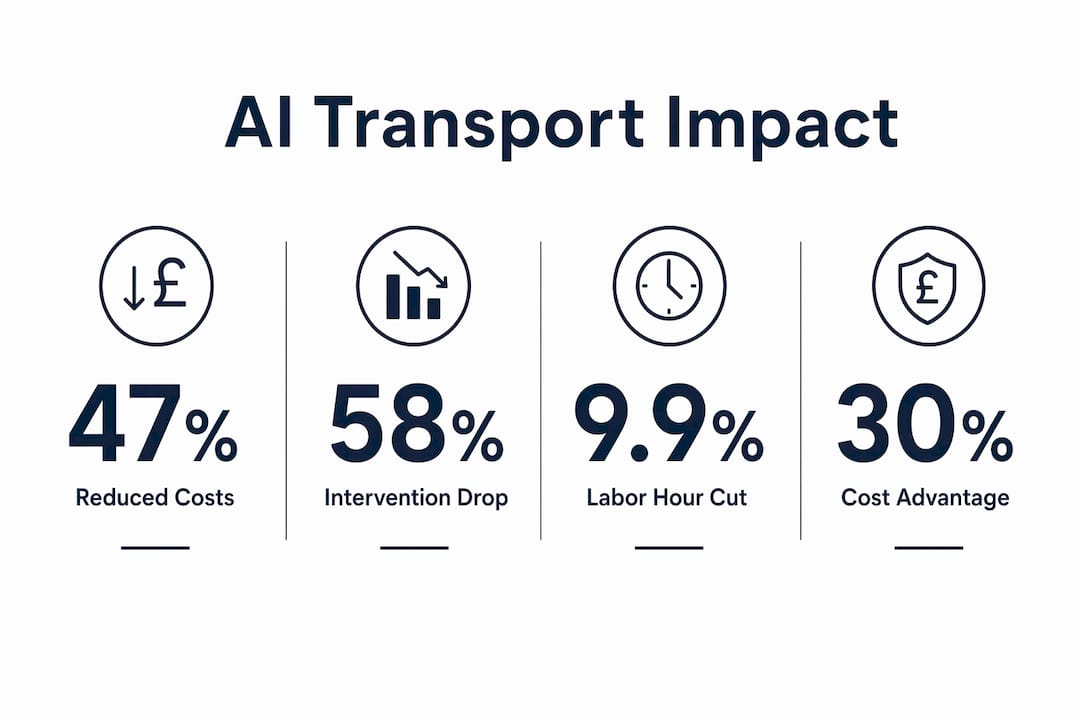
Decision latency tells a similar story. Moving from a monolithic to an agentic architecture reduced decision latency from 11 minutes to 91 seconds and improved operating margins by 340 basis points. Faster decisions mean fewer cascading delays across the network.
The cost reduction at the exception level is equally striking. In a 600-agent mesh deployment, cost per exception event fell from $47 to $9. That reduction compounds across tens of thousands of weekly shipments into significant annual savings.
| Metric |
Before agentic AI |
After agentic AI |
| Human intervention rate |
58% |
11% |
| Shipments autonomously orchestrated |
Below 50% |
92% |
| Decision latency |
11 minutes |
91 seconds |
| Cost per exception event |
$47 |
$9 |
| Operating margin improvement |
Baseline |
+340 basis points |
UPS reinforces this picture at enterprise scale. The company reduced US labour hours by 9.9% through AI-driven logistics management. For a network of UPS’s size, that figure represents hundreds of thousands of hours redirected or removed from the cost base entirely.
Understanding AI logistics decision-making at this level of granularity is what allows transport managers to build a credible internal business case for adoption.
What are the main challenges in scaling AI transport management systems?
Scaling AI in transport is primarily a systems engineering problem, not an algorithm problem. The main barrier to scaling AI is building integrated, governed workflows with operational intelligence, not finding a more powerful model. This distinction matters because most teams invest in model selection and underinvest in the infrastructure that makes models reliable at scale.
The two most dangerous failure modes are confidence drift and exception amplification. Confidence drift occurs when an AI model continues making high-confidence decisions in conditions that have shifted away from its training data. Exception amplification happens when a single misclassified event triggers a cascade of downstream errors across the network. Both failures are mitigated through continuous recalibration, circuit-breaker logic, and human escalation frameworks. Without these controls, a scaling AI system becomes a scaling liability.
The practical engineering requirements for a production-grade, scalable AI transport system include:
- Continuous monitoring of model confidence scores against live operational data
- Circuit-breaker logic that pauses autonomous decisions when confidence falls below defined thresholds
- Human escalation paths that are fast, clearly defined, and not treated as failure states
- Data integrity checks running in real time across all input feeds
- Audit trails for every autonomous decision, enabling post-event analysis and recalibration
The shift from isolated AI pilots to integrated agent meshes is where most organisations stall. A pilot running on clean, curated data in a controlled corridor will perform well. The same system deployed across a fragmented, multi-carrier, multi-region network will degrade without the governance layer in place.
Pro Tip: Before scaling any AI transport system beyond a pilot, map every data source feeding the model and identify which ones lack a clear owner. Unowned data feeds are the most common cause of model degradation at scale. Assign ownership before you scale, not after.
How do data strategies and digital twins enhance AI scalability in transport?
A single source of truth is the foundation of any AI system that scales reliably. Fragmented data and the absence of unified data architectures stall AI deployment regardless of model quality. When different parts of a logistics network feed conflicting data into the same AI system, the model cannot make consistent decisions. The result is not just inaccuracy. It is unpredictable inaccuracy, which is far harder to manage.
Digital twins extend this principle into real-time network modelling. A digital twin is a live, continuously updated virtual model of the physical logistics network. It allows transport managers to run what-if scenarios, test routing changes, and identify bottlenecks before they affect live operations. Modern scalable AI depends on integrated real-time digital twins that compress traditional supply chain engineering timelines from months to minutes.
UPS operates one of the most advanced examples in production. Its digital twin updates every 10 minutes, continuously self-healing and adjusting the global network in response to live conditions. That cadence means the model is never more than ten minutes behind reality, which is the operational standard required for autonomous decision-making at scale.
C.H. Robinson’s Lean AI Engineer demonstrates what unified data enables at the planning layer. The system can assess an entire supply chain in 25–30 minutes, a task that previously required up to four weeks of manual effort. That compression is not a product of a better algorithm alone. It is the product of a unified data architecture that the algorithm can query without friction.
Transport managers looking to adopt these data strategies should work through the following steps:
- Audit all current data sources feeding your TMS and identify gaps, duplicates, and unowned feeds.
- Establish a single source of truth for carrier performance, shipment status, and exception history.
- Implement real-time data pipelines that update the AI system continuously rather than in batch cycles.
- Build a digital twin of your core network corridors before expanding to the full network.
- Define data lineage standards so every AI decision can be traced back to its source data.
Learning how to integrate AI into your logistics workflow starts with getting the data architecture right. The AI layer is only as good as the data layer beneath it.
Key takeaways
AI transport management scalability is achieved through agent-based architectures, unified data strategies, and governed workflows, not through more powerful algorithms alone.
| Point |
Details |
| Architecture determines cost scaling |
Agent-based systems scale costs sublinearly; monolithic TMS platforms scale costs superlinearly as volume grows. |
| Intervention rates drop sharply |
Agentic AI reduced human intervention from 58% to 11% within five months in documented deployments. |
| Exception costs fall at scale |
Cost per exception event dropped from $47 to $9 in a 600-agent mesh, compounding across large networks. |
| Data unity enables AI performance |
Fragmented data stalls AI regardless of model quality; a single source of truth is the prerequisite for reliable scaling. |
| Governance prevents failure at scale |
Circuit-breaker logic and continuous recalibration are required to prevent confidence drift and exception amplification. |
Why operational intelligence matters more than the algorithm
I have watched transport teams spend months selecting the most technically advanced AI model, then deploy it into a network with five different carrier data formats, no unified shipment history, and exception workflows that still run through a shared email inbox. The model fails. The team concludes that AI does not work for their operation. The real conclusion is that the infrastructure was not ready.
The industry has moved past the question of whether AI can scale in transport. The evidence from UPS, C.H. Robinson, and documented 4PL deployments answers that definitively. The question now is whether a given organisation has the operational intelligence layer to support it. That means governed data, defined escalation paths, and a monitoring framework that catches drift before it becomes a crisis.
The shift towards hybrid AI model approaches is also worth watching. Using large frontier models for broad task coverage alongside domain-specific models for precision reduces inference costs and improves reliability. This is not a future trend. It is already in production at leading operators.
My honest advice to any transport manager evaluating scalable AI: start with your data governance, not your model selection. The teams that scale successfully are not the ones with the best algorithm. They are the ones with the cleanest data and the clearest escalation logic.
— Vytautas
How Logivo supports scalable AI transport management
Transport managers who understand the architecture behind scalable AI need a platform that reflects those principles in practice. Logivo’s transport management software is built around AI-driven automation across job allocation, delivery tracking, and invoicing, reducing the administrative workload that grows fastest when networks scale without proper tooling.
Firms using Logivo report reduced invoicing errors, improved operational clarity, and lower overhead as their networks grow. The platform’s role-based access and security architecture mean that governance is built in, not bolted on. Logivo also offers a guided one-month trial, so transport managers can validate AI recommendations against their own operational data before committing. If you are building the case for scalable AI in your operation, that is a practical starting point.
FAQ
What is AI transport management scalability?
AI transport management scalability is the ability of an AI-driven transport system to handle growing shipment volumes without proportional increases in cost or human intervention. It is primarily achieved through agent-based architectures that distribute decision-making across specialised programs rather than routing everything through a central platform.
Agent-based systems resolve exceptions at the shipment level without central coordination, which eliminates the latency and bottlenecks that cause costs to grow faster than volume in monolithic TMS platforms. Documented deployments show cost advantages exceeding 30% for networks handling more than 20,000 shipments weekly.
What is confidence drift and why does it matter for AI scalability?
Confidence drift occurs when an AI model continues making high-confidence decisions after operational conditions have shifted away from its training data. It is one of the primary failure modes in scaled AI transport systems and requires continuous recalibration and circuit-breaker logic to prevent cascading errors.
How does a digital twin improve transport management scalability?
A digital twin is a live virtual model of the logistics network that updates continuously, allowing AI systems to make decisions based on current conditions rather than historical snapshots. UPS’s digital twin updates every 10 minutes, enabling real-time self-healing and network adjustment at global scale.
What is the first step to scaling AI in a transport operation?
The first step is establishing a single source of truth across all data feeds entering the AI system. Fragmented or unowned data stalls AI deployment regardless of model quality, and unified data architecture is the prerequisite for consistent, reliable autonomous decision-making.
Recommended