Predictive scheduling dispatch: a 2026 guide for transport managers
Discover the role of predictive scheduling dispatch in 2026. Transform transport operations with machine learning for efficiency and compliance.
Predictive scheduling dispatch: a 2026 guide for transport managers

Predictive scheduling dispatch is defined as the use of machine learning and real-time operational data to anticipate demand and assign jobs before they arise, replacing reactive allocation with forward-looking resource management. For dispatch professionals and transportation managers, this shift is not incremental. It changes how fleets are staffed, how routes are assigned, and how compliance is maintained. The role of predictive scheduling dispatch sits at the intersection of workforce planning, algorithmic decision-making, and regulatory adherence. Organisations that adopt it correctly report measurable gains in labour efficiency, driver utilisation, and schedule stability within the first year of deployment.
What is the role of predictive scheduling dispatch in transport operations?
Predictive scheduling dispatch functions as a control layer that pulls data from ERP systems, telematics, and transport management platforms to shift planning from reactive to anticipatory. Rather than waiting for a job to appear and then finding a driver, the system forecasts demand patterns and pre-positions resources accordingly. This distinction matters because reactive dispatch creates idle time, overtime spikes, and last-minute allocation errors that compound across a working week.
The industry term for this practice is demand-driven dispatch, though “predictive scheduling dispatch” has become the working shorthand among logistics professionals. Both terms describe the same core function: using historical patterns, live traffic data, and workforce availability to generate assignments with high confidence before the operational window opens.
Efficient dispatch strategies built on predictive models reduce labour costs by 5–15% through better staffing and overtime control. Initial deployments typically yield a 3–5% labour expense decrease in the first year, with return on investment achieved within 3–6 months. That timeline is short enough to justify a phased pilot before full fleet rollout.

How does predictive scheduling cut costs and improve efficiency?
The financial case for predictive analytics in scheduling rests on three levers: eliminating overstaffing, reducing idle time, and controlling overtime. Each lever operates independently, but they compound when addressed together through a unified forecasting model.
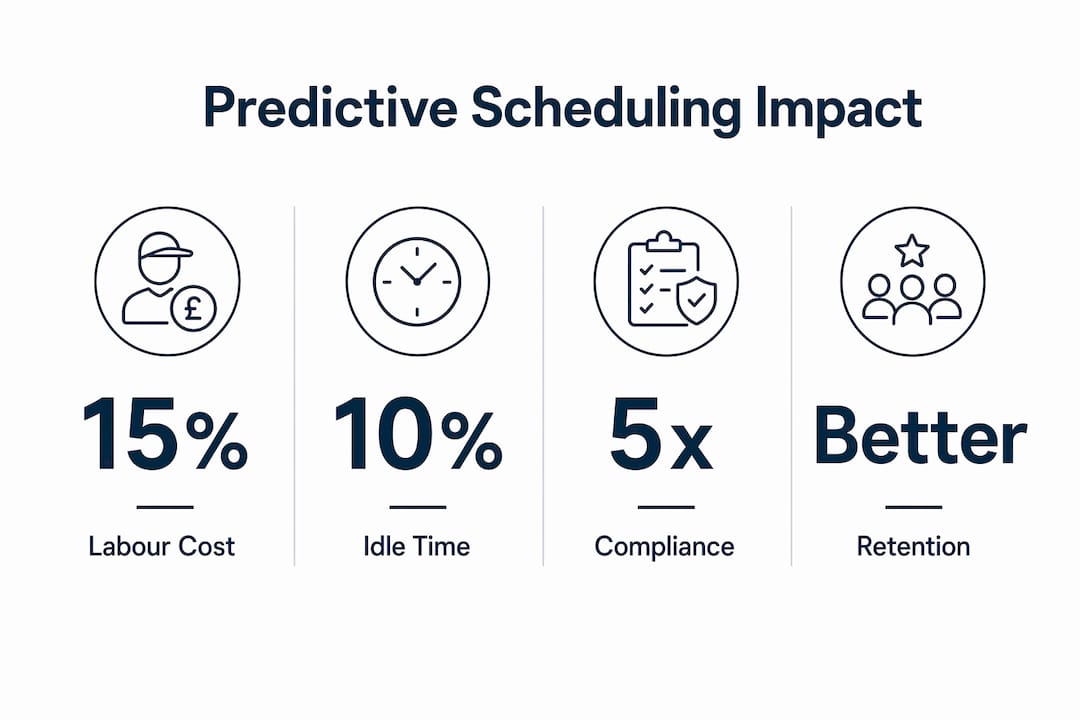
Overstaffing is the most visible cost. When demand forecasts are inaccurate, managers schedule buffer drivers who sit idle during quiet periods. Predictive models trained on historical demand data remove that buffer by producing staffing recommendations calibrated to actual expected volume. The result is fewer paid hours with no corresponding work.
Idle time is subtler but equally costly. Drivers waiting between assignments represent sunk labour cost. Predictive dispatch systems use real-time telematics integration to reassign drivers dynamically as jobs complete, reducing the gap between drop-off and the next pickup.
The efficiency gains in specialised fleets are striking. Advanced predictive dispatch models have achieved a 91% reduction in service delays in distributed service fleets, alongside a 27.5% improvement in algorithm convergence speed. Those figures come from restroom cleaning fleet deployments, but the underlying scheduling logic applies directly to courier and haulage operations.
Key efficiency gains from predictive scheduling include:
- Labour cost reduction of 5–15% through accurate demand forecasting and overtime prevention
- Reduced idle time through dynamic reassignment based on live job completion data
- Faster algorithm throughput, with some frameworks improving convergence by 10% over traditional schedulers
- ROI within 3–6 months for initial deployments, making the business case straightforward
What technology powers predictive scheduling dispatch systems?
The algorithms behind modern predictive dispatch are more sophisticated than simple rule-based schedulers. Two approaches dominate current deployments: hierarchical graph neural networks for large fleets, and multi-agent reinforcement learning for dynamic urban environments.
Hierarchical graph-based frameworks treat the fleet as a network of nodes and edges, where each driver, job, and location is a node with weighted connections. The system learns global patterns across the entire network while simultaneously running local optimisation for individual assignments. Graph neural network frameworks maintain per-step latency under 1 second while scheduling fleets of up to 500 agents. That sub-second latency is what makes real-time dispatch viable at scale.
Multi-agent reinforcement learning takes a different approach. Each driver agent learns from its own assignment history while coordinating with other agents to avoid conflicts. Dual-graph reinforcement learning models that represent both agent state and task structure improve decision stability under dynamic urban demand. This matters for city courier operations where demand spikes are unpredictable.
The technology stack supporting these algorithms includes:
- ERP integration for job data, customer contracts, and billing rules
- Telematics feeds for live vehicle location, speed, and estimated arrival times
- Workforce management systems for driver availability, certifications, and hours worked
- Scheduling databases for historical demand patterns and seasonal adjustments
Data quality determines whether any of these algorithms perform well. Clean, unified operational data is the decisive factor for effective predictive scheduling. Organisations that attempt to deploy predictive dispatch on top of fragmented or inconsistent data sources consistently underperform those that invest in data hygiene first.
Pro Tip: Before selecting an algorithm or platform, audit your ERP and telematics data for completeness and consistency. A six-week data audit typically reveals gaps that would otherwise cause the model to produce unreliable forecasts from day one.
How do you balance automation with human oversight in dispatch workflows?
Predictive dispatch does not replace dispatchers. It changes what they spend their time on. The most effective implementations use a tiered decision model: the system auto-posts high-confidence assignments for standard routes, while flagging complex or high-risk cases for supervisor review.
Auto-posting high-confidence assignments while routing exceptions to supervisors balances automation efficiency with human judgement on costly or risky decisions. A driver with a specialist certification assigned to a hazardous goods route, for example, requires a human check that the certification is current and the vehicle is compliant. The algorithm identifies the best match; the dispatcher confirms the compliance detail.
Phased deployment is the standard approach for building trust in the system. Starting with bounded, high-volume workflows such as recurring route assignments or dock scheduling allows the model to calibrate before it encounters complex exceptions. Teams that attempt full automation from day one typically encounter edge cases the model has not seen, which erodes confidence and triggers manual overrides that undermine the system’s learning.
Best practices for balancing automation and human oversight:
- Define auto-post thresholds based on job type, driver history, and route complexity before go-live
- Create a clear exception queue so supervisors see only the cases that genuinely require their judgement
- Embed compliance validation within the scheduling workflow so regulatory checks run automatically before any assignment is confirmed
- Review override patterns weekly to identify where the model consistently underperforms and needs retraining
Pro Tip: Track the ratio of auto-posted to supervisor-reviewed assignments each week. A healthy deployment typically auto-posts 70–80% of standard jobs within the first three months. If that ratio is lower, the model needs more training data or the auto-post thresholds are set too conservatively.
What is the impact of predictive scheduling on workforce satisfaction and compliance?
The advantages of predictive scheduling extend well beyond cost reduction. Schedule predictability directly affects driver retention. Stable scheduling improves workforce satisfaction and reduces absenteeism, which in turn improves service quality and profitability. Drivers who know their schedules in advance plan their lives around them. Those who receive last-minute changes disengage and eventually leave.
Fair workweek legislation in multiple jurisdictions now mandates advance notice periods for schedule changes, with financial penalties for violations. Predictive scheduling systems address this directly by generating schedules days or weeks ahead of the operational window. Continuous compliance checking embedded in the scheduling process prevents costly labour violations that manual processes routinely miss.
The compliance benefits include:
- Advance notice compliance for jurisdictions requiring 7–14 days’ notice of schedule changes
- Mandatory rest break enforcement built into the assignment logic, preventing illegal consecutive shift patterns
- Predictability pay risk reduction by avoiding last-minute schedule changes that trigger penalty payments
- Employee consent rule tracking for voluntary overtime and shift swaps
Predictive scheduling also supports intraday management. Continuous re-forecasting and targeted callouts refine schedules throughout the day to manage unexpected absences and demand shifts. When a driver calls in sick at 6:00 AM, the system identifies the best available replacement based on proximity, hours worked, and certification, rather than leaving a dispatcher to work through a contact list manually.
The workforce impact compounds over time. Lower absenteeism reduces the frequency of last-minute replacements. Fewer last-minute replacements mean fewer compliance violations. Fewer violations mean lower penalty costs and better driver relations. The impact of scheduling dispatch on retention is therefore both direct and systemic.
Key takeaways
Predictive scheduling dispatch reduces labour costs, improves compliance, and increases driver retention by replacing reactive job allocation with data-driven, forward-looking workforce management.
| Point |
Details |
| Labour cost reduction |
Predictive models cut staffing costs by 5–15% through accurate demand forecasting and overtime control. |
| Technology foundation |
Graph neural networks and reinforcement learning enable sub-second dispatch decisions across fleets of 500 or more vehicles. |
| Data quality first |
Clean, unified ERP and telematics data is the prerequisite for reliable predictive scheduling outcomes. |
| Phased deployment |
Starting with high-volume recurring routes allows model calibration before scaling to complex exceptions. |
| Compliance automation |
Embedded compliance checks prevent fair workweek violations and reduce predictability pay penalties automatically. |
What I have learned from watching predictive dispatch mature in logistics
The technology has moved faster than most transport managers expected. Three years ago, graph neural network dispatch was a research concept. Today it runs in production environments scheduling hundreds of drivers in real time. What has not moved as fast is organisational readiness.
The organisations that struggle with predictive dispatch share a common pattern: they treat it as a software installation rather than a process change. They buy the platform, connect the data feeds, and expect the model to perform. When it does not, they blame the algorithm. The real problem is almost always data fragmentation or undefined business rules that the model cannot infer on its own.
My honest advice is to spend as much time on data preparation and rule documentation as you do on platform selection. The algorithm is the easy part. Getting your ERP, telematics, and workforce systems to speak the same language is where the real work happens. Organisations that do this groundwork first see results within the first quarter. Those that skip it spend months troubleshooting outputs that look plausible but are subtly wrong.
The future of predictive dispatch will involve tighter integration between scheduling and AI-assisted transport workflows, with models that adapt intraday without human intervention. That capability exists in research environments now. It will be in mainstream platforms within two to three years. The transport managers who build clean data foundations today will be the ones who can adopt those capabilities without a painful migration.
— Vytautas
How Logivo supports predictive scheduling dispatch in transport operations
Transport managers who want to put predictive scheduling into practice need a platform that connects job allocation, telematics, and compliance in one place.
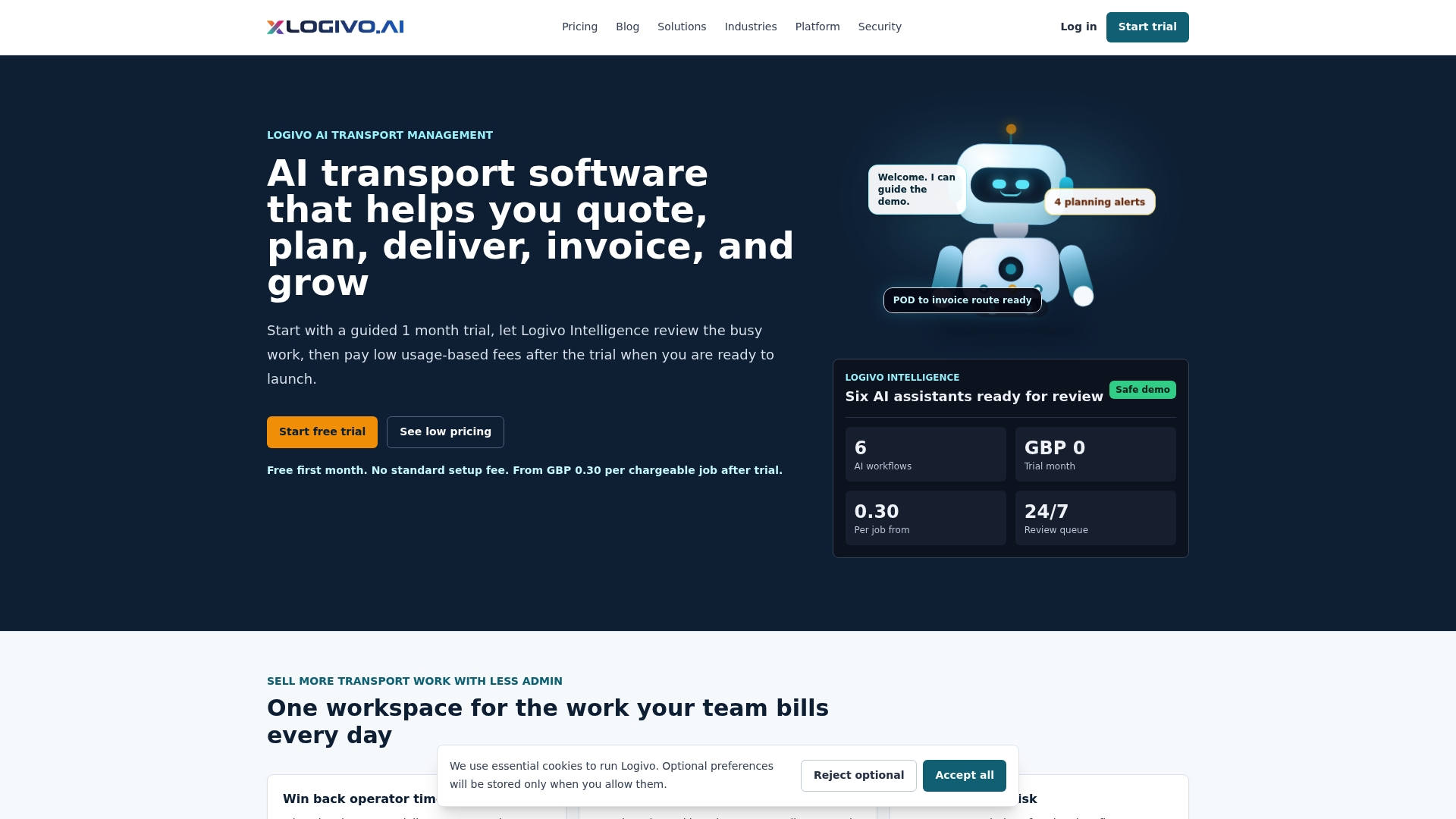
Logivo’s transport management software integrates AI-driven dispatch recommendations with live driver tracking, ERP data, and invoicing in a single platform. The system automates job allocation, flags compliance risks before schedule posting, and reduces administrative workload across the operation. Logivo offers a guided one-month trial, so your team can validate AI recommendations against real jobs before committing. Firms using Logivo report improved operational clarity and fewer invoicing errors, which translates directly to lower overhead and higher customer satisfaction.
FAQ
What is predictive scheduling dispatch?
Predictive scheduling dispatch uses machine learning and real-time data to forecast demand and assign jobs before they arise, replacing reactive allocation with forward-looking workforce management.
How much can predictive scheduling reduce labour costs?
Predictive scheduling reduces labour costs by 5–15% through better staffing accuracy and overtime control, with initial deployments typically delivering a 3–5% reduction in the first year.
What data sources does predictive dispatch require?
Effective predictive dispatch integrates ERP job data, telematics feeds, and workforce management systems. Data quality and consistency across these sources determines forecast reliability.
How does predictive scheduling help with regulatory compliance?
Predictive scheduling systems embed continuous compliance checks that enforce advance notice requirements, mandatory rest breaks, and employee consent rules before any schedule is posted.
How long does it take to see results from predictive dispatch?
Most organisations achieve return on investment within 3–6 months of initial deployment, particularly when they start with bounded, high-volume workflows such as recurring route assignments.
Recommended