Why AI transforms supply chain visibility in 2026
Discover why AI transforms supply chain visibility in 2026, boosting productivity by over 40% and enhancing decision-making for companies.

AI-driven supply chain visibility is defined as the use of machine learning, predictive analytics, and autonomous agents to convert fragmented logistics data into real-time, forward-looking intelligence. This is why AI transforms supply chain visibility so fundamentally: it shifts operations from reactive reporting to prescriptive decision-making. Companies deploying AI-enabled supply chain platforms have achieved productivity increases of more than 40% since 2022. That figure reflects not marginal improvement but a structural change in how supply chains operate. Advanced AI-first strategies can also reduce working capital by 30% and improve EBITDA by 2–4 percentage points, according to BCG. The industry term for this shift is “supply chain intelligence,” and it goes well beyond traditional track-and-trace.
What are the key ways AI enhances supply chain visibility?
Traditional visibility tools function like a rearview mirror. They tell you what happened. AI functions like a radar system, forecasting where problems will emerge and surfacing recommendations before disruptions occur.
The most significant change is in data integration. AI platforms ingest internal data (orders, inventory, shipments) alongside external signals such as weather patterns, port congestion indices, and geopolitical alerts. Predictive ETA models use more than 150 variables to forecast arrival times with far greater accuracy than GPS alone. That level of granularity was simply not achievable with manual processes or legacy systems.
AI also shifts visibility across three distinct intelligence layers:
- Descriptive analytics: What happened? Traditional dashboards and reporting tools operate here.
- Predictive analytics: What will happen? Machine learning models flag risks before they materialise, using signals from weather, carrier performance history, and demand shifts.
- Prescriptive analytics: What should we do? AI recommends specific actions, such as rerouting a shipment or reallocating inventory, before a disruption causes financial damage.
The prescriptive layer is where the real competitive advantage lies. Most organisations still operate at the descriptive level. Moving to prescriptive intelligence requires AI-driven predictive capabilities that most legacy platforms cannot support.
Pro Tip: Before investing in a new AI visibility platform, audit which intelligence layer your current tools operate at. If your team is still manually reviewing exception reports, you are operating at the descriptive level and leaving significant efficiency gains on the table.
The concept of autonomous supply chain operations is also emerging rapidly. AI agents handle multistep workflows without human intervention, from flagging a delayed shipment to automatically rebooking capacity on an alternative carrier. This is not theoretical. One firm automated 60% of status check calls and 80% of paper invoice payments using 50 AI agents. The operational impact of that scale of automation is profound.

The financial case for AI in supply chain is well documented and specific. AI-driven forecasting reduces errors by 20–50% compared to traditional methods. Fewer forecasting errors mean less safety stock, lower write-offs, and tighter cash cycles.
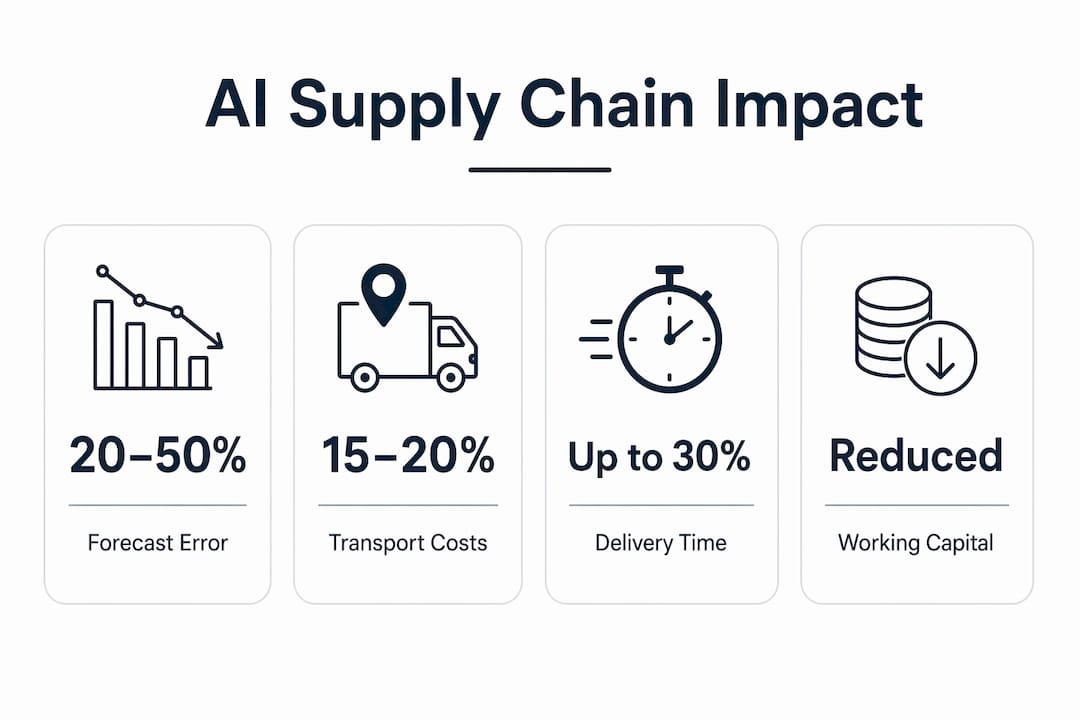
Route optimisation powered by AI cuts transport costs by 15–20%, and predictive analytics shortens delivery windows by up to 40%. Those are not incremental gains. They represent the difference between a logistics operation that reacts to problems and one that prevents them.
| Outcome |
AI-driven improvement |
| Forecasting error reduction |
20–50% versus traditional methods |
| Logistics cost savings |
Up to 15% overall; 15–20% on transport |
| Delivery window accuracy |
Up to 40% improvement |
| Working capital reduction |
Up to 30% with AI-first strategies |
| EBITDA improvement |
2–4 percentage points |
The working capital reduction deserves particular attention. Excess inventory is one of the largest hidden costs in any supply chain. AI visibility tools give planners the confidence to hold less stock because they can see demand signals and supply risks earlier. That confidence translates directly into cash freed from the balance sheet.
Automation of routine tasks also drives productivity gains that compound over time. When AI handles invoice payment automation and status updates, operations teams redirect their attention to exception management and supplier relationships. The result is a leaner, more responsive organisation.
Pro Tip: When building the business case for AI visibility investment, model the working capital benefit separately from the cost-saving benefit. Finance teams respond more readily to balance sheet improvements than to operational efficiency metrics alone.
What organisational changes does AI visibility actually require?
Technology is the easier part of AI adoption. The harder part is organisational. Most AI supply chain implementations fail without a unified, clean data foundation. Fragmented data across ERP systems, carrier portals, and warehouse management tools produces unreliable AI outputs. Garbage in, garbage out remains the most accurate description of what happens when AI meets poor data hygiene.
Successful adoption requires several structural changes:
- Data unification: All relevant data sources must feed into a single, governed data layer before AI can produce reliable recommendations.
- Process reengineering: AI cannot simply be bolted onto existing workflows. Processes must be redesigned around AI outputs, not the other way around.
- Operating model redesign: Successful AI transformation demands redesigning operating models with leadership focused on enterprise-level outcomes, not just tactical visibility metrics.
- Executive sponsorship: CEO and C-suite involvement is non-negotiable. AI-driven solutions require cross-functional coordination across procurement, manufacturing, and distribution. Without executive authority to resolve trade-offs, AI recommendations stall at departmental boundaries.
The shift from reactive to proactive execution also changes what supply chain teams do day to day. A context-driven execution layer, as described by Supply Chain Management Review, ingests signals from orders, shipments, and inventory to forecast risks in motion and prioritise the highest-impact disruptions. Human attention moves from routine monitoring to genuine exception management. That is a significant change in job design, not just tooling.
Organisations that treat AI as a software purchase rather than a capability transformation consistently underperform. The ones that succeed redesign their teams, their data architecture, and their decision-making processes simultaneously.
What future capabilities does AI-enhanced visibility unlock?
The next frontier in supply chain visibility is AI agents operating across end-to-end workflows. These are not simple automation scripts. AI agents handle complex, multistep decisions that previously required senior analyst time.
- Exception resolution at scale: An AI agent detects a port delay, identifies affected shipments, calculates the financial impact, and presents ranked rerouting options within minutes.
- Multi-variable optimisation: AI can produce ranked, multi-variable optimised solutions within an hour, replacing the siloed quick fixes that typically result from human-only decision-making.
- Cross-functional trade-off resolution: AI agents break traditional supply chain trade-offs by expanding the feasible decision space, enabling enterprise-wide optimisations that no individual team could calculate manually.
- Autonomous carrier management: AI monitors carrier performance in real time, flags underperformance against SLA thresholds, and recommends reallocation before service failures affect customers.
The trajectory is toward fully autonomous supply chains where AI handles the majority of operational decisions and humans focus on strategy, relationships, and edge cases that require judgement. That future is closer than most supply chain managers expect.
“Companies with AI-driven visibility were three times more likely to experience minimal impact during global disruptions. The gap between AI-enabled and traditional supply chains widens with every major disruption event.”
Source: BCG, 2026
Practical steps for teams ready to move forward include auditing current data quality, identifying the three highest-cost exception types in your operation, and piloting AI visibility tools on a single lane or product category before scaling. The AI logistics decision-making improvements documented across 2025 and 2026 show that early movers gain compounding advantages as their models improve with more data.
Key takeaways
AI transforms supply chain visibility by replacing reactive reporting with predictive intelligence that prevents disruptions before they occur, delivering measurable gains in cost, speed, and resilience.
| Point |
Details |
| Predictive intelligence over reporting |
AI shifts visibility from descriptive dashboards to prescriptive recommendations using 150+ variables. |
| Proven financial outcomes |
AI-first strategies reduce working capital by up to 30% and improve EBITDA by 2–4 percentage points. |
| Data foundation is non-negotiable |
Clean, unified data is the prerequisite for reliable AI outputs; fragmented data produces unreliable results. |
| Executive sponsorship drives adoption |
CEO-level commitment is required to resolve cross-functional trade-offs that AI recommendations surface. |
| AI agents expand decision capacity |
Autonomous agents handle multi-variable optimisation within an hour, replacing slow, siloed human fixes. |
The uncomfortable truth about AI and supply chain visibility
Supply chain managers often ask me which AI platform to buy. That is the wrong question. The right question is whether your organisation is ready to act on what AI tells you.
I have seen operations invest in sophisticated visibility platforms and then ignore the recommendations because the procurement team and the logistics team could not agree on who owned the decision. The technology worked. The organisation did not. AI surfaces trade-offs that humans have been avoiding for years. Without executive authority to resolve those trade-offs, the recommendations sit in a dashboard and nothing changes.
The other thing I would push back on is the idea that data quality is someone else’s problem. Every supply chain leader I respect has made data governance a personal priority, not an IT project. The organisations that get the most from AI visibility tools are the ones where the supply chain director can tell you exactly which data sources feed their models and why they trust them.
AI does genuinely change what is possible. Companies with AI-driven visibility were three times more likely to weather global disruptions with minimal impact. That resilience advantage is real and growing. But it accrues to organisations that have done the unglamorous work of cleaning their data, redesigning their processes, and getting their leadership aligned. The technology is the easy part.
— Vytautas
How Logivo supports AI-driven supply chain visibility
Supply chain managers who want to move from reactive tracking to real-time, AI-powered visibility need a platform built for that purpose from the ground up.
Logivo’s transport management software integrates real-time freight tracking, automated status updates, and AI-based decision support within a single platform. Teams using Logivo report reduced invoicing errors, lower administrative overhead, and clearer operational visibility across their entire fleet. Logivo also offers a guided one-month trial, so your team can validate AI recommendations against your actual operations before committing. For transport operators ready to put the insights from this article into practice, Logivo provides the live driver tracking and automated workflows that make AI-enhanced visibility operational from day one.
FAQ
What does AI-driven supply chain visibility mean?
AI-driven supply chain visibility means using machine learning and predictive analytics to convert logistics data into real-time, forward-looking intelligence. It goes beyond tracking to forecast disruptions and recommend corrective actions before problems occur.
How much can AI reduce logistics costs?
AI route optimisation cuts transport costs by 15–20%, and AI-driven forecasting reduces errors by 20–50% compared to traditional methods, according to industry research from 2026.
Why do AI supply chain projects fail?
Most AI supply chain implementations fail due to fragmented or poor-quality data and the absence of CEO-level sponsorship to resolve cross-functional trade-offs. Technology alone cannot compensate for weak data foundations or misaligned organisational structures.
What is a context-driven execution layer?
A context-driven execution layer is an AI system that ingests signals from orders, shipments, and inventory simultaneously to forecast risks in motion and prioritise the highest-impact disruptions for human attention.
How quickly can AI agents resolve supply chain exceptions?
AI agents can produce ranked, multi-variable optimised solutions within an hour, replacing the slower, siloed decision-making that typically delays exception resolution in traditional supply chain operations.
Recommended