Role of AI in shipment lifecycle: 2026 guide
Discover the critical role of AI in shipment lifecycle management. Learn how AI automates processes for seamless logistics and maximize efficiency.
Role of AI in shipment lifecycle: 2026 guide

AI is defined as the core engine of modern shipment lifecycle management, automating every stage from order creation through to carrier payment. The role of AI in shipment lifecycle operations has moved well beyond simple tracking alerts. Advanced 4PL platforms now orchestrate over 92% of shipments autonomously using AI across the full lifecycle. That figure signals a structural shift, not a gradual improvement. For logistics managers and supply chain professionals, understanding how AI achieves this, and where it delivers the greatest return, is no longer optional.
How does AI automate each stage of the shipment lifecycle?
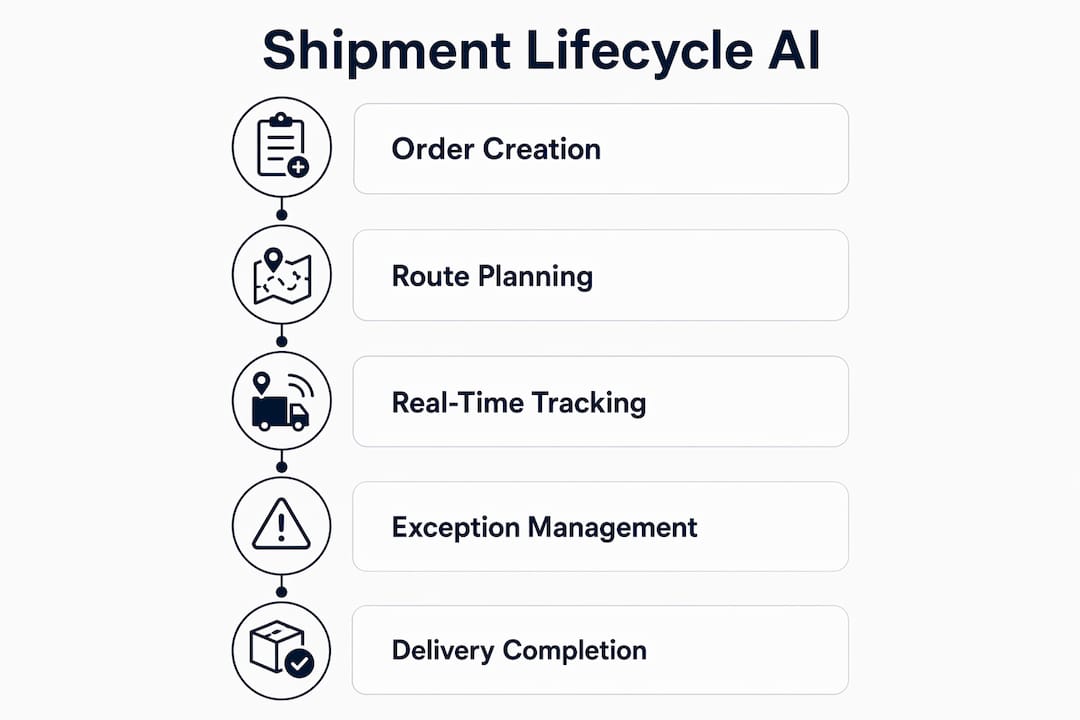
AI applies across every stage of what the industry formally calls end-to-end shipment orchestration. This covers order intake, route planning, carrier selection, real-time tracking, exception handling, documentation, and payment. Each stage has historically required manual input. AI replaces or reduces that input at every point.
Order creation and route planning
AI planning agents ingest order data and apply predictive analytics to select the optimal carrier, route, and departure window. They weigh variables including lane rates, transit times, carrier performance history, and current network capacity. This process, which previously took a dispatcher several minutes per shipment, runs in seconds at scale.
Real-time tracking and predictive rerouting
AI tracking systems pull data from GPS feeds, port APIs, and weather services to monitor shipments continuously. When a delay is detected, the system calculates alternative routes and flags the best option before the disruption affects the delivery window. This moves logistics teams from reactive to proactive operations, which is the defining shift of Logistics 4.0.

Automated exception management and document processing
Exception management is where AI saves the most time in daily operations. AI agents identify shipment anomalies, cross-reference contract terms, and either resolve the issue automatically or escalate it with a recommended action. On the documentation side, one company automated 73% of order acceptances and 80% of invoice payments through targeted back-office automation. That converts hours of manual processing into near-instant execution.
Pro Tip: Connect your transport management system to a live carrier data feed before deploying AI routing. The quality of AI decisions depends directly on the freshness and completeness of the data it receives.
What business impacts can logistics professionals expect from AI?
The benefits of AI in freight are measurable and consistent across company sizes. Implementing AI in logistics reduces costs by 5–20%, cuts procurement expenses by 5–15%, and can boost productivity by over 40%. These are not theoretical projections. They reflect outcomes from companies that have moved AI from pilot projects into core operations.
| Impact area |
Reported outcome |
| Logistics cost reduction |
5–20% reduction across transport spend |
| Procurement savings |
5–15% reduction in supplier and carrier costs |
| Productivity gains |
Over 40% increase in advanced AI adopters |
| Invoice automation |
Up to 80% of paper invoices processed automatically |
| Order acceptance |
Up to 73% of acceptances handled without human input |
The productivity figure deserves attention. A gain of over 40% does not come from working faster. It comes from removing the repetitive tasks that consume the most time, including status calls, document chasing, and manual data entry. AI in logistics management redirects that capacity toward decisions that actually require human judgement.
“AI should be seen as an accelerant to existing proprietary data, carrier networks, and operational experience rather than a bolt-on tool replacing human talent. Effective companies use AI to expand their decision space and find optimised cost-service balances.” — BCG, 2026
The impact of AI on shipping also shows up in service consistency. When AI handles exception resolution automatically, delivery reliability improves because problems are caught and addressed before they escalate. Logistics managers report fewer customer complaints and faster resolution times as a direct result. You can find concrete AI logistics decision-making examples that illustrate these outcomes across different freight models.
How do you integrate AI into shipment lifecycle management?
Integration is where most logistics teams encounter difficulty. The technology is available. The challenge is deploying it in a way that builds on existing workflows rather than disrupting them.
-
Start with narrow, repetitive tasks. Automate appointment scheduling, document classification, and status update notifications first. These are rules-driven and low-risk. Starting with discrete repetitive tasks before scaling to complex decisions reduces implementation risk significantly.
-
Use a closed-loop architecture. The most effective AI systems combine planning and execution agents with analytical and learning agents. Closed-loop AI architectures allow the system to refine its logic based on real shipment outcomes, creating a self-improving feedback loop rather than a static set of rules.
-
Integrate data across all workflows. Siloed AI systems produce siloed results. Connect your order management, transport management, and finance systems so the AI has a complete picture of each shipment. Fragmented data is the single biggest reason AI recommendations miss the mark.
-
Require explainability from your AI system. AI systems that provide transparent rationales for their recommendations build trust with the teams using them. Supply chain assessments powered by AI complete in under 30 minutes versus up to four weeks manually. That speed is only useful if the team understands and trusts the output.
-
Redefine human roles before go-live. AI reduces cognitive load by automating repetitive tasks, which shifts human roles toward exception management and strategic decisions. Define those new responsibilities clearly before deployment, or teams will revert to manual habits.
Pro Tip: Map your current exception rate before deploying AI. If 15% of your shipments generate manual interventions, that is your baseline. Measure against it monthly to track real AI impact.
A practical guide on how to integrate AI into your logistics workflow covers the sequencing of these steps in more detail, including how to align your carrier network data with AI planning tools.
What does the future of AI in shipment lifecycle management look like?
The next phase of AI technology in supply chain management moves beyond task automation into continuous, self-directed optimisation. Several developments are already reshaping how logistics professionals think about the future.
- Generative AI for real-time decision support. Generative AI models can synthesise data from multiple sources and present logistics managers with scenario options in plain language. This makes complex trade-off decisions faster and more accessible across the team.
- Self-healing supply chains. Continuous learning systems detect patterns in shipment failures and adjust routing, carrier selection, and scheduling logic automatically. The supply chain corrects itself without waiting for a human to identify the problem.
- Sustainability criteria in AI optimisation. AI systems are beginning to incorporate carbon emissions data into route and carrier selection. This allows logistics teams to balance cost, speed, and environmental impact simultaneously rather than treating sustainability as a separate reporting exercise.
- Multi-agent systems managing entire networks. Rather than optimising individual shipments, multi-agent AI systems coordinate decisions across entire carrier networks and customer bases simultaneously. This is the direction that advanced 4PL orchestration is heading.
- Workforce transformation. As AI handles more execution tasks, logistics roles will shift toward AI governance, exception strategy, and supplier relationship management. Teams that develop these skills now will have a structural advantage.
Key takeaways
AI in the shipment lifecycle delivers measurable cost savings, productivity gains, and service improvements when deployed through closed-loop architectures that combine real-time orchestration with continuous learning.
| Point |
Details |
| End-to-end automation |
AI manages order creation, routing, tracking, exceptions, and payments without manual input at each stage. |
| Proven cost impact |
AI reduces logistics costs by 5–20% and procurement spend by 5–15% in advanced adopters. |
| Start narrow, then scale |
Begin with repetitive tasks like document classification before tackling complex multi-variable decisions. |
| Closed-loop architecture |
Planning and learning agents must work together for AI to self-improve on live freight data. |
| Human roles shift |
Teams move from manual processing to exception strategy and AI governance as automation matures. |
Why I think most logistics teams are still underestimating AI
Most logistics professionals I speak with treat AI as a tracking upgrade. They expect better visibility and perhaps faster alerts. What they do not expect is that AI will change the fundamental structure of how their team spends its time. That gap in expectation is where most implementations fall short.
The teams that get the most from AI are not the ones with the most sophisticated technology. They are the ones that redesigned their workflows before go-live. They decided in advance which decisions would stay with humans and which would be handed to the system. That clarity is what separates a successful deployment from an expensive experiment.
The other thing I have observed is that explainability matters more than accuracy in the early stages. A system that is right 95% of the time but cannot explain its reasoning will be overridden constantly by cautious operators. A system that is right 85% of the time but shows its working will be trusted and adopted. Trust is the real implementation challenge, not the technology itself.
AI is not a replacement for logistics expertise. It is a multiplier of it. The professionals who treat it that way, using it to expand what they can see and decide rather than to replace what they already know, are the ones building genuinely resilient operations.
— Vytautas
How Logivo supports AI-driven transport management
Logistics teams looking to put these principles into practice need a platform that connects AI planning, tracking, and finance within a single workflow rather than across separate tools.
Logivo brings AI-driven job allocation, live shipment tracking, and automated invoicing into one platform, reducing the administrative overhead that consumes logistics teams daily. Firms using Logivo report fewer invoicing errors, greater operational clarity, and lower overhead as a direct result. Logivo also offers a guided one-month trial, so you can validate AI recommendations against your own freight data before committing. Explore Logivo’s transport management software to see how it fits your operation, or review the European freight team solution if your network operates across EU lanes.
FAQ
What is the role of AI in the shipment lifecycle?
AI automates and optimises every stage of the shipment lifecycle, from order creation and route planning through to real-time tracking, exception management, and carrier payment. Advanced platforms now orchestrate over 92% of shipments autonomously using AI.
How does AI reduce logistics costs?
AI reduces logistics costs by 5–20% and procurement expenses by 5–15% by eliminating manual processing, improving carrier selection, and resolving exceptions faster than human teams can.
What is a closed-loop AI architecture in logistics?
A closed-loop AI architecture combines planning and execution agents with analytical and learning agents. The learning layer analyses shipment outcomes and feeds intelligence back into the planning layer, allowing the system to improve continuously on live data.
How should logistics teams start integrating AI?
Start with narrow, rules-driven tasks such as appointment scheduling and document classification. Automating discrete repetitive processes first reduces risk and builds team confidence before scaling to complex, multi-variable decisions.
Does AI replace logistics staff?
AI does not replace logistics staff. It shifts human roles from manual processing toward exception management, AI governance, and strategic decision-making, which are higher-value activities that require human judgement.
Recommended