How AI TMS manages end-to-end logistics in 2026
Discover how AI TMS manages end-to-end logistics in 2026, streamlining operations with real-time data and automation for logistics managers.
How AI TMS manages end-to-end logistics in 2026

An AI transport management system (TMS) is defined as an autonomous orchestration platform that manages every stage of logistics operations, from order intake to final settlement, using machine learning and real-time data integration. Unlike traditional TMS tools that require constant human input, an AI TMS acts on data independently, selecting carriers, planning routes, tracking shipments, and resolving exceptions without manual prompts. Understanding how AI TMS manages end-to-end logistics is now a practical requirement for any logistics manager handling freight at scale. Platforms like Logivo demonstrate that AI logistics management works by connecting every workflow within a single governed system, replacing fragmented processes with coordinated, self-improving automation.
How AI TMS manages end-to-end logistics workflows
A modern AI TMS covers the full logistics lifecycle. End-to-end workflow coverage includes carrier selection, rate negotiation, routing, dispatch, tracking, and freight audit, all within a single governed execution platform. That scope matters because fragmentation between these stages is where cost and error accumulate.
The core workflows managed by an AI TMS break down as follows:
-
Order data ingestion. The system pulls order data directly from ERP, WMS, and CRM platforms. An AI TMS integrates with these upstream systems and carrier APIs to eliminate manual data entry and reduce human error at the point of origin.
-
Carrier selection and rate shopping. AI algorithms compare live carrier rates, service levels, and lane performance in real time. The system tenders freight to the best-fit carrier automatically, without a planner manually reviewing quotes.
-
Route planning and load consolidation. Machine learning models calculate the most efficient routes and consolidate loads to maximise trailer fill. AI load optimisation delivers 8%–15% better trailer utilisation compared to traditional rule-based algorithms. That improvement directly reduces the cost per shipment.
-
Shipment tracking and exception management. The system monitors every active shipment against planned milestones. When a delay or deviation occurs, it triggers automated communications to carriers, customers, and internal teams without waiting for a human to notice the problem.
-
Delivery confirmation and invoicing. Proof of delivery is captured digitally and matched against the original order. Invoicing runs automatically once delivery is confirmed, cutting the billing cycle from days to hours.
Pro Tip: Configure your AI TMS to flag exceptions by severity tier, not just by exception type. A missed collection window at a port carries a different cost impact than a delayed final-mile drop. Tiered alerting keeps your team focused on what actually matters.
How does AI enable autonomous decision-making in TMS?

The intelligence inside an AI TMS comes from a closed-loop architecture. Closed-loop AI systems run continuous improvement cycles by orchestrating shipments and studying results autonomously, without waiting for human alerts. Each completed shipment feeds data back into the model, which then adjusts routing logic, carrier preferences, and load parameters for the next cycle.
This is the critical distinction between an observational TMS and an orchestration layer. An observational tool shows you what happened. An orchestration layer acts on what is happening and learns from the outcome.
“AI-driven continuous intelligence enables proactive exception management and predictively adjusts shipments before disruption occurs. The system does not wait for a delay to be reported. It identifies the conditions that cause delays and reroutes before the problem materialises.”
AI-native platforms use teams of specialised, goal-driven agents coordinated around a common context layer. Each agent manages a distinct function: procurement, planning, visibility, or payment. They share data in real time and act within strategic guardrails set by the logistics manager.
Key characteristics of this autonomous decision-making model include:
- Machine learning routing models that improve with every shipment, not just at scheduled update intervals.
- Real-time data feeds from carrier APIs, traffic systems, and weather services that inform live rerouting decisions.
- Automated exception resolution that contacts carriers, updates ETAs, and notifies customers without human involvement.
- Agent-based governance that replaces legacy manual approval workflows with rule-based autonomy operating within defined boundaries.
The result is a system that gets measurably better over time. A logistics operation running an AI TMS in december is more efficient than the same operation was in january, because the models have processed months of real shipment outcomes.
What are the measurable benefits of AI TMS for logistics managers?
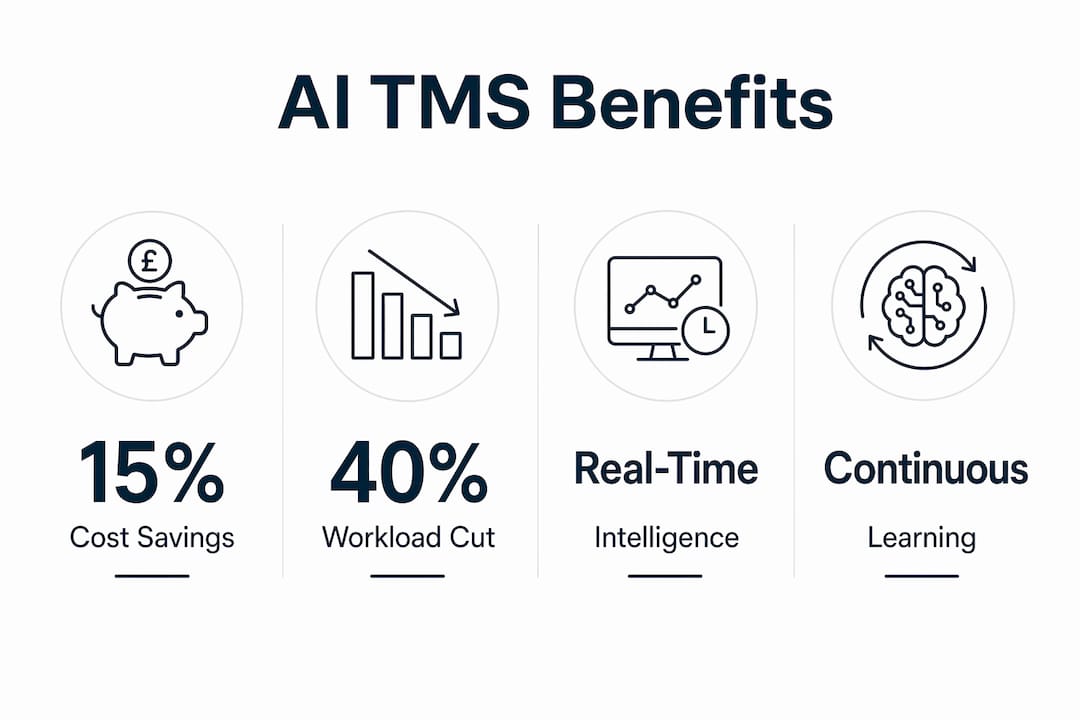
The performance gains from AI-driven transport management are well documented. Organisations implementing a modern TMS achieve an average 15% reduction in transportation expenses through optimised routing and load consolidation. That figure compounds as shipment volumes grow, because the AI finds efficiencies that manual planning cannot sustain at scale.
| Benefit |
Impact |
| Transportation cost reduction |
Average 15% saving via routing and load optimisation |
| Manual workload reduction |
Average 40% decrease through planning and documentation automation |
| Trailer utilisation improvement |
8%–15% gain over rule-based algorithms |
| Supply chain assessment speed |
25–30 minutes versus four weeks manually |
| Exception resolution |
Proactive, automated, before disruption reaches the customer |
TMS tools reduce manual transportation workload by an average of 40% through automation of planning and documentation. That freed capacity shifts planners from data entry to decision-making, which is a fundamentally different and more valuable use of their time.
Speed of intelligence is another underappreciated benefit. AI-native assessment technology completes a full supply chain evaluation in 25–30 minutes versus four weeks manually. For logistics managers who need to respond to network disruptions or carrier failures, that speed difference is operationally decisive.
Pro Tip: When building the business case for AI TMS adoption internally, anchor your cost projections on the 15% transportation expense reduction and the 40% workload reduction. These are conservative, documented figures that finance teams can validate independently.
How can logistics managers implement and govern AI TMS effectively?
Successful AI TMS adoption requires a governance mindset, not just a technology purchase. Effective logistics managers treat AI in a TMS not as a tool but as a virtual workforce governed by KPIs and strategy. That framing changes how you configure the system, measure its performance, and scale it over time.
Practical steps for implementation and governance:
- Audit your data flows first. An AI TMS is only as good as the data it receives. Clean, integrated feeds from your ERP and WMS are non-negotiable. Gaps in order data or carrier master records will produce poor routing decisions regardless of how capable the AI is.
- Define agent KPIs before go-live. Set measurable targets for each automated workflow: carrier acceptance rate, on-time delivery percentage, invoice accuracy rate. These KPIs become the guardrails within which the AI operates.
- Configure exception thresholds deliberately. Decide which exceptions the AI resolves autonomously and which require human review. Start conservatively and expand AI autonomy as trust in the system builds.
- Shift team roles toward oversight. Transitioning team roles to governing AI workflows rather than executing manual tasks enables logistics operations to scale without proportional headcount growth.
- Review AI decisions regularly. Schedule weekly reviews of automated decisions during the first three months. This is not micromanagement. It is the calibration period that ensures the AI’s logic aligns with your commercial priorities.
The AI transport management system governance model also demands attention to change management. Planners who previously owned carrier relationships and routing decisions need to understand their new role as governors of AI-driven processes. Teams that make this shift successfully report higher job satisfaction because they spend less time on repetitive tasks and more time on problems that require judgement.
Key takeaways
An AI TMS delivers measurable logistics gains only when it operates as a governed orchestration layer, not as a passive reporting tool.
| Point |
Details |
| Autonomous workflow coverage |
AI TMS manages carrier selection, routing, tracking, and invoicing without manual input at each stage. |
| Continuous self-improvement |
Closed-loop machine learning refines routing and load decisions with every completed shipment. |
| Documented cost savings |
Organisations report an average 15% reduction in transport costs and 40% less manual workload. |
| Governance over execution |
Logistics managers configure KPIs and exception rules; the AI executes within those boundaries. |
| Data quality is foundational |
Clean, integrated ERP and WMS data feeds determine the quality of every AI decision the system makes. |
The shift I did not expect when AI TMS became an orchestration layer
When I first worked alongside teams adopting AI TMS platforms, the conversation was almost entirely about cost reduction. Managers wanted to see the 15% transport saving and the workload numbers. Those gains arrived, and they were real. But the more significant shift was one nobody had put on the business case.
The planners stopped firefighting. Not because problems disappeared, but because the system resolved most exceptions before the team even knew they existed. That change in daily experience, from reactive to strategic, altered how those teams thought about their own roles. The best logistics managers I have seen thrive in AI-governed environments are the ones who stopped asking “what went wrong today” and started asking “what should the AI be optimising for next quarter.”
The pitfall I see most often is poor data integration at the start. Teams rush to configure AI workflows before their ERP and WMS feeds are clean. The AI then makes confident decisions on bad data, which erodes trust in the system faster than any technical failure would. Get the data right first. The AI will do the rest.
The future direction is clear. Lean AI orchestration points toward supply chains that self-heal continuously, adapting logic in real time without human intervention. Logistics leaders who build governance competency now will be positioned to run those networks. Those who wait will find themselves managing systems they do not understand and cannot direct.
— Vytautas
How Logivo supports end-to-end AI transport management
Logistics managers who want to move from manual execution to AI-governed operations have a practical starting point in Logivo. Logivo’s transport management software brings together autonomous shipment orchestration, real-time delivery tracking, load optimisation, and automated invoicing within a single platform.
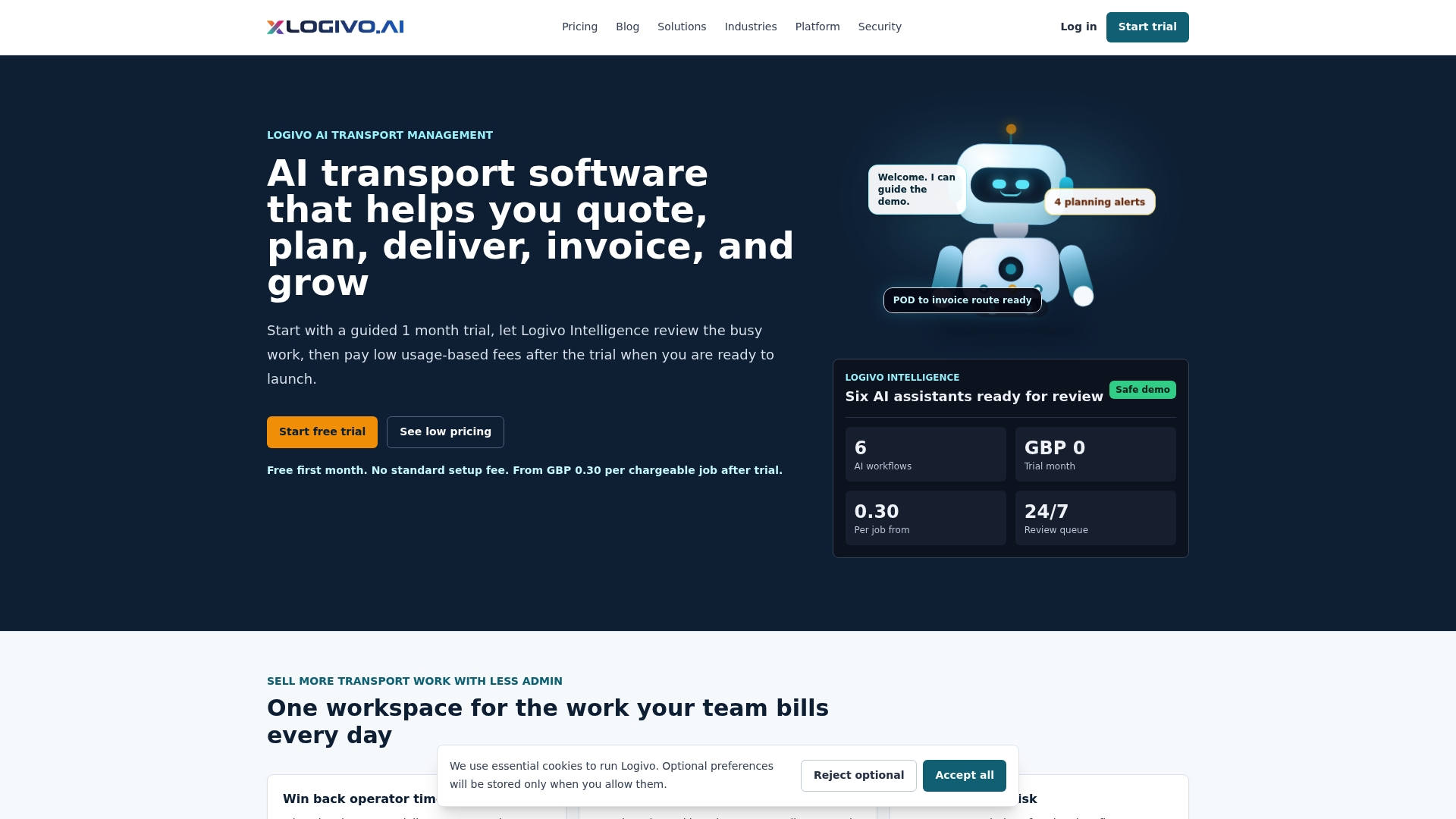
Logivo reduces administrative workload by automating job allocation, driver communication, and billing, tasks that typically consume hours of planner time each day. Firms using Logivo report fewer invoicing errors and greater operational clarity across their freight networks. Logivo also offers a guided one-month trial, so logistics teams can validate AI recommendations against their own shipment data before committing. For operations ready to move beyond spreadsheets and reactive planning, Logivo provides the AI-driven logistics foundation that scales with freight volume.
FAQ
What is an AI TMS?
An AI TMS is a transport management system that uses machine learning and real-time data to autonomously manage logistics workflows from order creation to final settlement, including carrier selection, routing, tracking, and invoicing.
How does AI TMS reduce transportation costs?
Organisations implementing a modern TMS achieve an average 15% reduction in transportation expenses through AI-optimised routing and load consolidation, with trailer utilisation improving by 8%–15% over rule-based systems.
What logistics workflows does an AI TMS automate?
An AI TMS automates carrier selection, rate shopping, route planning, load consolidation, shipment tracking, exception management, proof of delivery capture, and freight invoicing across all transport modes.
How does AI TMS improve over time?
Closed-loop AI systems study the outcome of every completed shipment and adjust routing logic, carrier preferences, and load parameters automatically, making each subsequent cycle more efficient without human intervention.
What do logistics managers need to govern an AI TMS effectively?
Logistics managers need clean ERP and WMS data feeds, clearly defined agent KPIs, configured exception thresholds, and a team culture that treats AI oversight as a strategic function rather than a technical task.
Recommended